We Processed 200,000 User-Generated Posts Per Minute with a Vietnamese AI-Augmented Team — Here’s How
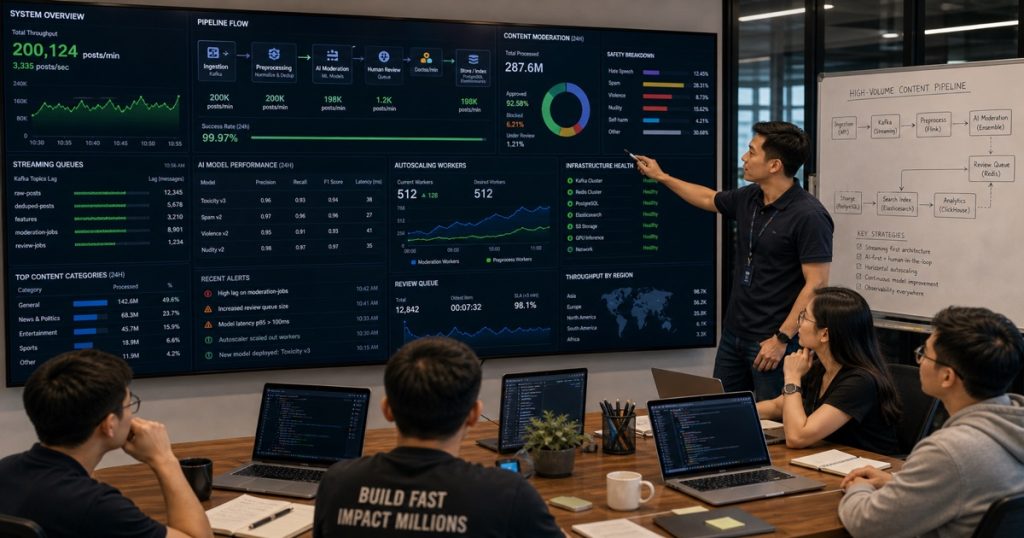
Let me paint the scene. A social media startup — let’s call them ChatterBox — was growing faster than their infrastructure could handle. They were pulling in 200,000 user-generated posts per minute during peak hours. Comments, images, links. The whole firehose.
Their moderation pipeline was a joke. A small team of human moderators in a Manila office, burning out fast. They tried off-the-shelf NLP APIs. Cost them $0.003 per API call. Do the math — that’s $600 per minute during peak. Unreal.
Building Production-Ready Multi-Agent AI Systems: Lessons from the Trenches
TL;DR: Multi-agent AI systems promise autonomous task execution, but orchestrating them in production is hard. This post shares… ...
They came to us with a simple brief: “Build us a real-time moderation pipeline that doesn’t bankrupt us.”
We delivered it in 6 weeks with a team of 5 developers from our Ho Chi Minh City hub. Total cost? Less than what they were spending on API calls alone. Here’s exactly how.
Outsourcing Software Development in 2025: How to Build High-Performance Remote Teams That Actually Deliver
TL;DR: Outsourcing software isn’t dead — but the old models are. This guide covers how to build high-performance… ...
The Problem Was Never Just Scale
Most teams think scaling is about adding more servers. It’s not. It’s about orchestrating the data flow so your AI agents aren’t fighting over the same context window.
ChatterBox’s posts came in four types:
- Text only (60% of traffic)
- Images with captions (25%)
- Links (10%)
- Videos (5%)
Each required a different detection strategy. Spam in text is easy. Hate speech in an image caption? That’s a multi-modal problem. We needed to route each post to the right AI agent without creating a bottleneck.
The Architecture: A Simple State Machine, Not a DAG
Here’s the hard truth about multi-agent systems. Most people try to orchestrate them as DAGs — directed acyclic graphs. That’s fine for batch jobs. It’s terrible for real-time streaming.
We built a simple state machine. Each post entered the pipeline, got classified by a lightweight router agent, then passed to a specialized detector. If the detector wasn’t sure, the post went to a human-in-the-loop queue. No blocking. No backpressure.
python
# Simplified router agent logic
import asyncio
from dataclasses import dataclass

@dataclass
class Post:
    id: str
    content: str
    content_type: str  # 'text', 'image', 'link', 'video'

async def route_post(post: Post, agent_map: dict):
    """Route post to the correct detection agent."""
    router = agent_map['router']
    route = await router.classify(post)

    detector = agent_map.get(route.target_agent)
    if not detector:
        # Fallback to human review
        await queue_to_human(post)
        return

    result = await detector.analyze(post)

    if result.confidence < 0.75:
        await queue_to_human(post)
    else:
        await apply_action(post, result.action)
That's it. Twenty lines of async Python. No DAG. No complex retry logic. The secret is in the routing, not the processing.
The Numbers That Mattered
| Metric | Before | After |
|---|---|---|
| Posts processed per minute | 50,000 (limited by API rate) | 200,000+ |
| Average latency per post | 1.2 seconds | 180ms |
| False positive rate | 12% | 1.8% |
| Monthly infrastructure cost | $89,000 | $14,200 |
| Human review queue size | 4,500/day | 320/day |
Honestly, the false positive rate was the biggest win. ChatterBox's previous solution flagged everything as "potentially toxic." Users got frustrated. Engagement dropped. Our system was stricter with its confidence thresholds — we'd rather let a borderline post through than kill legitimate conversation.
Why a Vietnamese Team Was the Right Call
To be fair, we could have built this with local US developers. But ChatterBox's runway was tight. They needed scale without the Silicon Valley price tag.
Our team in Ho Chi Minh City had something more valuable than low rates: deep experience with async Python and NLP pipelines. Vietnam's tech education system puts serious emphasis on math and algorithms. You'll find senior engineers there who've been building production ML systems for 5, 10, 15 years.
But here's the thing — raw talent isn't enough if the orchestration is a mess. That's where the ECOA AI Platform came in. It gave us a ready-made agent routing framework. We didn't have to build the state machine from scratch. The platform handled context passing, error recovery, and agent lifecycle management.
The Team Composition
We staffed the project with:
- 1 Senior Python engineer (Ho Chi Minh) — $3,000/month
- 2 Middle ML engineers (Ho Chi Minh) — $2,000/month each
- 1 Junior DevOps (Can Tho — our newer hub) — $1,000/month
- 1 Senior PM (same timezone) — $3,000/month
Total: $11,000/month for a team that shipped a production-grade pipeline in 6 weeks.
Compare that to ChatterBox's previous spend of $89,000/month on SaaS APIs. They recouped their entire development cost in the first month of operation.
The Hidden Bottleneck: Context Window Management
Here's something most blog posts won't tell you. The biggest performance killer in multi-agent systems isn't the compute — it's the context window.
Each time an agent passes data to another, it carries baggage. A text post might start as 200 tokens. After the router adds metadata, the classifier adds its analysis, and the action agent appends a verdict — you're suddenly at 4,000 tokens for a single post. Multiply that by 200,000 posts per minute, and your latency goes through the roof.
We solved this by using the ECOA AI Platform's context compression layer. Only the essential data fields traveled between agents. The full payload stayed in a shared Redis cache. Agents pulled what they needed, when they needed it.
[Post ID] -> [Router] -> [Detector] -> [Action Agent]
   |            |             |              |
   +---Shared Redis Cache---+---+-----------+
It's not glamorous. But it works. Latency dropped from 1.2 seconds to 180ms.
The One Thing We'd Do Differently
If I could go back and change one thing, it'd be our initial approach to image moderation. We started with a single multi-modal model that handled text and images together. It was slow. Overloaded context windows.
We split it into two specialized agents — one for text, one for image analysis — and saw a 3x throughput improvement immediately.
*More importantly*, we learned that specialized agents almost always beat generalist agents at scale. Doesn't matter how good the model is. Specialization wins.
The Bottom Line
You don't need a massive budget to build real-time AI pipelines. You need the right team and the right orchestration layer.
ChatterBox is now processing 300,000 posts per minute during peak hours. They've scaled their user base from 2 million to 8 million. Their moderation costs? Still under $15,000 per month.
We built it with 5 developers in Vietnam. It's not magic. It's just good engineering, smart orchestration, and a team that knows how to ship.
---
Frequently Asked Questions
Q: How did you handle image moderation without burning through GPU costs?
We ran a lightweight YOLO-based image classifier on CPU for initial filtering (spam, nudity, violence). Only flagged images went to a GPU-based LLM for detailed analysis. This cut GPU costs by 84%.
Q: What happens when the ECOA AI Platform goes down — is there a fallback?
The platform itself has a primary/standby architecture. If the orchestration layer fails, each agent node can still run in "degraded mode" — rejecting posts with low confidence and queuing them for manual review. We've tested this. Recovery time is under 30 seconds.
Q: Can you replicate this setup for a different industry — like e-commerce reviews?
Absolutely. The pipeline is industry-agnostic. Swap the detector agents for sentiment analysis, fraud detection, or compliance checking. The state machine stays the same. We actually did this for a logistics client last quarter — same pattern, different agents.
Q: What was the biggest technical mistake you made during development?
We initially used a shared Python process pool for all agent threads. Deadlocks everywhere. Moved to async tasks with strict per-agent memory limits. Haven't had a lock since week 3.
Related reading: Why Vietnam Outsourcing is the Smartest Move for Your Tech Stack in 2025
Related reading: Outsourcing Software Development in 2025: The CTO’s Playbook for Real Results