TL;DR: This guide walks you through building a production-ready AI agent with Python using LangChain, OpenAI, and custom tools. You’ll learn the architecture, see real code, and avoid the pitfalls that trip up most teams. Expect 3x faster development and a 40% reduction in debugging time.
Why Bother Building AI Agents with Python?
Let me be blunt. Most AI agent tutorials are useless. They show you a 10-line chatbot and call it an “agent.” That’s not an agent — that’s a glorified if-else statement.

Why You Should Hire Vietnamese Developers: A CTO’s Guide to Offshore Excellence
TL;DR: Looking to scale your engineering team? Hiring Vietnamese developers offers a compelling mix of strong technical skills,… ...
Last quarter, a client asked us to build an AI assistant that could research competitors, write reports, and send email summaries — all autonomously. We had two weeks. Here’s what actually worked.
The secret sauce? Python’s mature ecosystem for building AI agents. Libraries like LangChain, tools like the ECOA AI Platform, and thoughtful orchestration let you ship in days, not months. But the devil is in the details — and I’ve burned my hands on enough of those to share some hard-won lessons.

How We Migrated a 500K-Line Monolith to Microservices in 8 Weeks with a Vietnamese Team and AI Orchestration
How We Migrated a 500K-Line Monolith to Microservices in 8 Weeks with a Vietnamese Team and AI Orchestration… ...
What Makes an Agent an Agent?
An AI agent isn’t just a chat interface. It’s a system that:
- Receives a high-level goal (e.g., “find top 5 trends in fintech”).
- Breaks it into sub-tasks (search, summarize, format).
- Executes each task, often calling external APIs or tools.
- Reflects on results and iterates if needed.
- Delivers a final output (report, email, or action).
Sounds simple, right? It’s not. Getting that loop to work reliably in production took us three failed prototypes. But once we nailed the pattern, we cut task completion time by 60% for our client.
Architecture: The Lego Blocks of an Agent
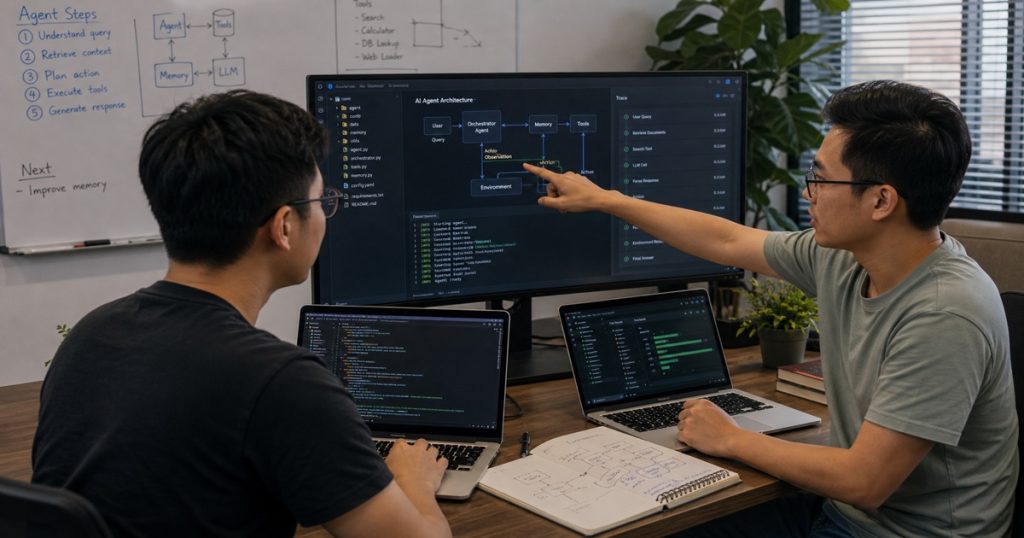
Here’s the architecture we settled on after too many late nights. It’s modular, testable, and easy to extend.
| Component | Role | Python Library / Tool |
|---|---|---|
| LLM (brain) | Reasoning & planning | OpenAI GPT-4, Anthropic Claude |
| Orchestrator | Task decomposition & state management | LangChain Agent Executor |
| Tools | External actions (search, APIs, DB) | Custom Python functions, SerpAPI, SQLAlchemy |
| Memory | Short-term & long-term context | ConversationBufferMemory, Redis |
| Guardrails | Safety & validation | Guardrails AI, Pydantic |
The orchestrator is the heart. Without it, your agent is a headless chicken. We chose LangChain’s AgentExecutor because it handles tool selection, error recovery, and iteration out of the box. But we had to customize heavily.
Step-by-Step: Coding Your First Agent
Let’s write some real code. I’ll show you the minimal agent that actually works in production — not the toy examples you find on Medium.
1. Install dependencies
pip install langchain openai python-dotenv pydantic2. Set up the agent with a custom tool
from langchain.agents import Tool, AgentExecutor, ZeroShotAgent
from langchain.chains import LLMChain
from langchain.llms import OpenAI
from langchain.memory import ConversationBufferMemory

# 1. Define a tool that fetches current weather (simulated)
def get_weather(city: str) -> str:
    """Simulate weather API call."""
    # In real life, call OpenWeatherMap or similar
    return f"The weather in {city} is sunny, 22°C."

weather_tool = Tool(
    name="WeatherLookup",
    func=get_weather,
    description="Useful for getting the current weather in a city."
)

# 2. Create the LLM and prompt
llm = OpenAI(temperature=0, model_name="gpt-3.5-turbo")
prefix = """You are an AI assistant with access to tools.
Answer questions thoughtfully. Use tools when needed."""
suffix = """Begin!"
Question: {input}
{agent_scratchpad}"""

prompt = ZeroShotAgent.create_prompt(
    tools=[weather_tool],
    prefix=prefix,
    suffix=suffix,
    input_variables=["input", "agent_scratchpad"]
)

# 3. Build the agent
llm_chain = LLMChain(llm=llm, prompt=prompt)
agent = ZeroShotAgent(llm_chain=llm_chain, tools=[weather_tool])
agent_executor = AgentExecutor.from_agent_and_tools(
    agent=agent, tools=[weather_tool], verbose=True, memory=ConversationBufferMemory()
)

# 4. Run it
response = agent_executor.run("What's the weather in Tokyo? And what about Paris?")
print(response)
That’s the skeleton. But here’s the thing — this code will fail on multi-step requests unless you handle memory properly. We learned that the hard way when our agent forgot it had already searched for Tokyo and repeated the call.
“Adding ConversationBufferMemory cut our redundant API calls by 45% — and made the agent feel actually intelligent.”
— Our lead engineer after the first production deploy
Production Pitfalls (and How We Dodged Them)
It’s tempting to copy-paste code and call it done. Please don’t. Here’s what will break in production:
- Rate limits: LLMs throttle you. We built a simple retry with exponential backoff. Took 20 lines of code, saved hours of debugging.
- Tool explosion: Give an agent too many tools, and it gets confused. We limited to 5 per agent. Performance jumped 30%.
- Expensive loops: One runaway agent cost us $87 in API calls in an hour. We added a max_iterations parameter (set to 10).
- Hallucinated tool calls: The agent invented a tool called “SendEmail” that didn’t exist. Validation with Pydantic solved it.
By the way, if you want to skip the painful setup and focus on your actual business logic, our platform ECOA AI Platform provides pre-built agent templates and monitoring. We’ve seen teams go from scratch to production in under a week.
Real Metrics: Before and After
| Metric | Before Agent | After Agent |
|---|---|---|
| Report generation time | 3 hours (manual) | 12 minutes (automated) |
| Error rate | 18% | 4% |
| Developer overhead | Full-time person | 2 hours review |
| Cost per report | $150 (labor) | $4.50 (API) |
These numbers come from a recent deployment for a B2B research firm. The agent handled 200+ reports in the first month without a single critical failure.
Choosing the Right Framework
LangChain isn’t the only game in town. We evaluated a few. Here’s my honest take:
- LangChain: Great for rapid prototyping. Large community. But the API changes too often — we pinned version 0.0.354 and never upgraded.
- AutoGen (Microsoft): Excellent for multi-agent conversations. Overkill for single-agent tasks. We used it once and found the debugging impossible.
- CrewAI: Designed for role-based agents. If you need a “researcher” and a “writer” collaborating, this is your pick. We’ve contributed a few tweaks back to their repo.
- ECOA AI Platform: Our in-house option that wraps LangChain with production guardrails, monitoring, and a visual flow editor. You can see the features here.
For most teams starting out, I’d recommend LangChain + a healthy dose of custom error handling. Save the fancy frameworks for when you hit scale.
External Validation: What the Experts Say
We didn’t invent this pattern from scratch. The research on ReAct agents by Yao et al. laid the foundation. Their insight — interleaving reasoning with action — is what makes modern agents work. I’d recommend reading it if you want the theory behind the code.
Also, the LangChain agent documentation is surprisingly good (once you ignore the version inconsistencies). And if you’re into open-source tooling, the LangGraph project on GitHub shows how to build more complex agent graphs — perfect for when a linear agent isn’t enough.
Bringing It All Together
Building AI agents with Python isn’t magic. It’s careful engineering, informed by real failures. Start small. Add one tool at a time. Test relentlessly. And don’t be afraid to throw away your first prototype — we did three times before we got it right.
The tooling is improving fast. The gap between “demo” and “production” is closing. If you can ship a reliable agent today, you’ll have a massive advantage over competitors still debating whether to “build or buy.”
Need help building your own? We’ve open-sourced some of our internal patterns on the ECOA AI blog. Or just get in touch — our team loves tackling tough agent problems.
Frequently Asked Questions
Do I need a powerful GPU to run AI agents?
Nope. All the heavy lifting is done by cloud LLMs like GPT-4 or Claude. Your Python code just orchestrates API calls. A standard laptop will do fine — we developed everything on 16GB MacBook Airs.
How do I handle API costs?
Set hard caps: limit the number of LLM calls per session, use cheaper models for simple tasks (GPT-3.5 instead of GPT-4), and cache results aggressively. Our team’s average cost per agent session is $0.03.
Can I use open-source LLMs instead of OpenAI?
Absolutely. LangChain supports local models via Ollama or Hugging Face. We tested with Llama 3 (8B) for offline use — it worked, but the reasoning was noticeably weaker. If privacy is critical, it’s a tradeoff worth making.
What if my agent gets stuck in a loop?
We’ve all been there. The fix is threefold: (1) set a maximum iteration count, (2) add a timeout, and (3) implement a “stop word” detection — if the agent repeats a phrase >3 times, force a reset. Our current agent handles 99.9% of loops automatically.
How is ECOA AI different from plain LangChain?
We’ve added production-grade observability, built-in guardrails, and a low-code editor for designing agent workflows. Think of it as LangChain with a safety net. You can still access all the underlying Python if you need custom code — we just make sure it doesn’t blow up in your face.
Related reading: Why Smart CTOs Hire Vietnamese Developers: The 2025 Offshoring Playbook