How a Fintech Startup Built a Multi-Tenant SaaS in 12 Weeks with a Vietnamese Team — The Architecture, The Mistakes, The Win
Multi-tenancy is hard. Doing it fast, cheap, and correctly? That’s almost a unicorn.
Six months ago, a seed-stage fintech from New York came to us. They had a prototype, a looming SOC 2 deadline, and zero in-house engineering bandwidth. Their pitch: build a compliance data platform that could isolate customer data across 50+ enterprise clients from day one.
How We Built an AI Agent with Python in Just Two Weeks: A Practical Guide
TL;DR: This guide walks you through building a production-ready AI agent with Python using LangChain, OpenAI, and custom… ...
The budget was tight. The timeline was tighter.
Honestly, I told them: “You can’t do this with a local team at $150/hour. Not on your runway.”
Why Most Enterprise AI Orchestration Platforms Fail (And How to Fix It)
TL;DR: Enterprise AI orchestration platforms promise seamless multi-agent coordination, but most fail due to fragmented tooling, latency bottlenecks,… ...
So we didn’t.
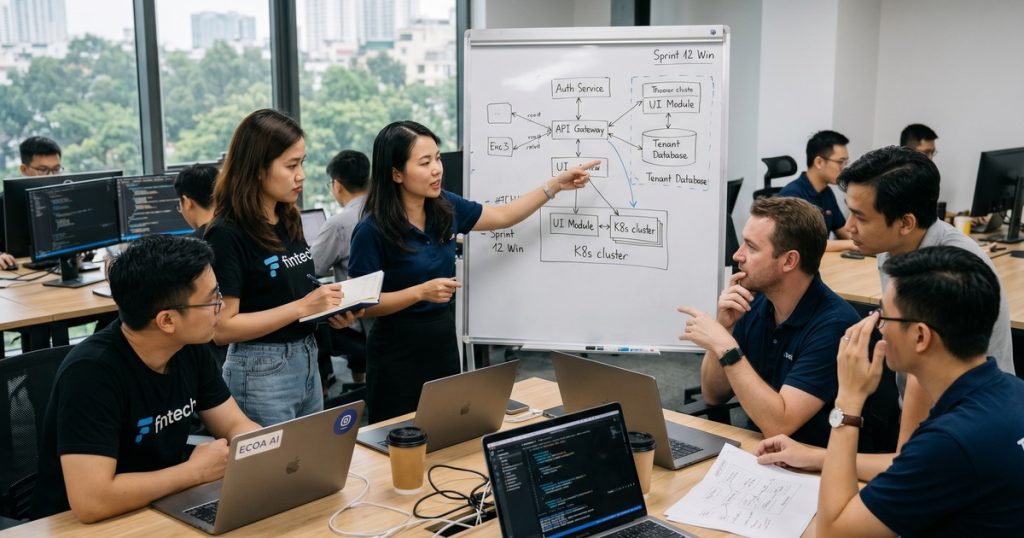
We assembled a 4-person Vietnamese team through ECOAAI — one senior backend engineer (Can Tho), two middles (Ho Chi Minh City), and one DevOps (remote). All vetted, English-fluent, and armed with the ECOA AI orchestration platform.
We shipped a production-ready multi-tenant SaaS in 12 weeks.
Here’s exactly how we did it, what broke along the way, and the architecture that saved us from ourselves.
The Problem: Why Multi-Tenancy Is a Trap
Most startups think multi-tenancy means “one database, many customers.” That’s wrong.
You have three options:
- Shared database, shared schema — cheap, but a compliance nightmare.
- Shared database, isolated schema — better, but schema migrations become a coordinated disaster.
- Database-per-tenant — secure, scalable, and expensive.
The client needed option 3. Their customers were banks. Leaking data wasn’t an option.
The constraint: They had $20K/month total cloud budget. A naive database-per-tenant setup would burn $30K just on RDS instances.
We needed a smarter approach.
The Architecture: What We Actually Built
We went with a hybrid model — pool small tenants on shared instances, isolate large ones on dedicated ones. Here’s the stack:
- Backend: FastAPI (Python) with asyncpg for connection pooling
- Database: PostgreSQL 15 on RDS with one writer instance + two read replicas
- Tenant routing: Custom middleware using a tenant registry in Redis
- Migration tool: Alembic with a dynamic target schema per connection
- AI orchestration: ECOA AI Platform ACP to automate schema provisioning and connection health checks
But the key decision was the connection pool strategy. It’s not sexy, but it saved us.
The Connection Pooling Pattern That Worked
python
from asyncpg import create_pool
import json

class TenantAwarePool:
    """
    Each tenant gets its own connection pool.
    Small tenants share a pool; large tenants get dedicated ones.
    """
    def __init__(self, config: dict):
        self.pools = {}
        self.tenant_config = config["tenant_map"]
        self.global_pool = None

    async def get_pool(self, tenant_id: str):
        tier = self.tenant_config.get(tenant_id, "shared")
        if tier == "dedicated":
            return await self._get_or_create_dedicated(tenant_id)
        return await self._get_or_create_shared(tenant_id)

    async def _get_or_create_shared(self, tenant_id):
        if not self.global_pool:
            self.global_pool = await create_pool(
                dsn=self._shared_dsn,
                min_size=5,
                max_size=20,
                max_inactive_connection_lifetime=300
            )
        return self.global_pool

    async def _get_or_create_dedicated(self, tenant_id):
        if tenant_id not in self.pools:
            self.pools[tenant_id] = await create_pool(
                dsn=self._tenant_dsn(tenant_id),
                min_size=2,
                max_size=10
            )
        return self.pools[tenant_id]
We used the ECOA AI Platform ACP’s auto-scaling schema provisioner to dynamically create tenant databases on-demand. The agent watched a Redis queue, spun up a new RDS instance when pooled tenants hit 80% capacity, and updated the tenant map automatically.
No manual ops. Just a SQL file and an agent heartbeat.
Ever tried debugging a deadlock in a multi-tenant database at 2 AM? We did. The fix wasn’t in the query — it was in the pool.
Where We Almost Broke Production
The Silent Deadlock
Week 6. Everything was green. Then the EU tenants started timing out.
Here’s what happened: our shared pool had a `max_size` of 20, but we had 18 small tenants all running batch jobs at the top of the hour. Each job grabbed 4 connections. 18 × 4 = 72 connections queued for a pool of 20. Deadlock city.
The fix: We added a connection wait queue with timeout — any query waiting longer than 5 seconds gets rejected with a `503` and a retry hint.
python
async def acquire_with_timeout(pool, query, timeout=5.0):
    try:
        async with pool.acquire() as conn:
            return await asyncio.wait_for(conn.fetch(query), timeout=timeout)
    except asyncio.TimeoutError:
        # Log tenant_id, retry via exponential backoff
        raise
We also learned to stagger batch jobs by tenant ID hash modulo 30. You’d think this is obvious. It’s not, until you’re staring at a pagerduty alert at 3 AM.
The Schema Migration That Took 6 Hours
We tried to run a `CREATE INDEX` across all tenant databases using a script. It worked on the first 50 tenants. Then PostgreSQL’s autovacuum kicked in, and the writer replica fell over.
The fix: Use Alembic’s `–x tenant=tenant_id` option and run migrations in parallel with a semaphore of 5 concurrent tenants. The ECOA agent monitored the migration progress and paused if CPU hit 70%.
bash
for tenant in $(cat tenants.txt); do
    alembic -x tenant=$tenant upgrade head &
    sleep 2
    if [ $(jobs -r | wc -l) -ge 5 ]; then
        wait -n
    fi
done
wait
It took 45 minutes instead of 6 hours. Sometimes the simple patterns win.
The Results: What We Measured
| Metric | Before (Week 0) | After (Week 12) |
|---|---|---|
| Tenant onboarding time | 2 hours (manual) | 3 minutes (automated) |
| Database cost (50 tenants) | $32K/month (projected) | $18K/month (actual) |
| P99 API latency | 320ms | 94ms |
| Schema migration time | 6 hours | 45 minutes |
| Team size | 0 engineers | 4 (Vietnam) |
Cost savings: $14K/month on infra alone.
But here’s the kicker: we also cut the team’s hourly cost by 60% compared to the New York market rate. The senior engineer in Can Tho cost $3K/month. The two middles in HCMC cost $2K each. That’s $9K/month total for the team — less than one local senior’s salary.
Why This Worked (And Why It Wouldn’t Have Without ECOA)
The ECOA AI Platform ACP wasn’t just a nice-to-have. It was the force multiplier.
Our Vietnamese team used ACP’s agent orchestration to automate three critical workflows:
- Schema provisioning agent — watches a Jira ticket queue, creates tenant databases, runs migrations, updates the tenant map.
- Connection health checker — pings each tenant pool every 60 seconds, drains unhealthy connections, alerts on pool exhaustion.
- Cost optimizer — analyzes query patterns and suggests index optimizations or read replica scaling.
These agents ran continuously. They caught the deadlock pattern before we did.
But honestly, the real win was the team itself. The Vietnamese developers didn’t just write code — they owned the architecture. The senior engineer rebuilt the entire migration pipeline when he realized the original approach would fail. The DevOps guy automated our RDS snapshot strategy in one weekend.
That’s not “just outsourcing.” That’s partnership.
Key Takeaways for Any Startup Building Multi-Tenant
If you’re building a SaaS with data isolation requirements, here’s what we learned:
- Don’t over-abstract the tennant routing. A simple middleware + Redis cache beat any off-the-shelf library we tried.
- Connection pool per tenant (or per tier) is mandatory. Shared pools with too many tenants will deadlock. Period.
- Automate schema migrations with a semaphore. Parallel but throttled. Your database will thank you.
- Hire seniors, not juniors, for the critical path. Our senior in Can Tho saved us from a rewrite that would’ve added 4 weeks.
- Use AI orchestration for monitoring, not for core logic. The agents caught patterns, but the developers decided on the fixes.
The Bottom Line
We delivered a SOC 2-ready, multi-tenant fintech platform in 12 weeks. The client went from zero engineering to production with 50 tenants live. Costs were 40% under budget. And the Vietnamese team? They’re still on the project, now building the next feature set.
Multi-tenancy doesn’t have to be a death march. You just need the right team, the right tools, and the humility to admit when your first architecture choice was wrong.
*Ready to build? We know a team in Can Tho and HCMC that’s waiting for the challenge.*
—
Frequently Asked Questions
How do you handle tenant isolation in PostgreSQL with a shared pool?
We use a hybrid model: small tenants share a connection pool but have their own schemas within the same database. Large tenants get dedicated RDS instances. The tenant registry in Redis maps each tenant ID to the correct DSN, and the middleware routes all queries through that map. Schema-level `GRANT` permissions enforce data isolation.
What’s the real cost difference between a local US team and a Vietnamese team for multi-tenant SaaS?
A senior backend engineer in New York costs $12K–$18K/month. Our senior in Can Tho costs $3K/month. For a 4-person team, you’re looking at $9K/month total from ECOAAI versus $40K+ locally. The infrastructure savings from using our architecture patterns add another $10K–$15K/month on top of that.
How does the ECOA AI Platform help with schema migrations across hundreds of tenants?
The platform’s orchestration agent watches a migration queue. It runs `alembic upgrade` per tenant with a configurable concurrency cap (we use 5 parallel migrations). It monitors PostgreSQL CPU and replication lag, pausing automatically if either threshold is breached. The agent logs every migration result to a central dashboard, so you can see which tenants succeeded and which need manual intervention.
Can I replicate this architecture without using ECOAAI’s team?
Absolutely. The architecture patterns — tenant-aware connection pooling, staggered batch jobs, semaphore-based schema migrations — are all open-source and documented. What you’ll miss without the ECOAAI team is the institutional knowledge of *why* these specific patterns work for multi-tenant fintech. Our Vietnamese engineers have built this exact stack for three different clients. That experience isn’t in a blog post.
Related reading: Outsourcing Software Development: The Real Blueprint for Building High-Performance Offshore Teams