Human-in-the-Loop Orchestration: Why Your Multi-Agent System Still Needs a Human Operator
I’ve seen it a hundred times. A team builds a beautiful multi-agent system. Agents talk to each other, route tasks, make decisions in milliseconds. Everyone’s excited. Then production hits, and everything falls apart.
An agent approves a refund for a fraudulent transaction. Another agent escalates a routine password reset to the CEO’s inbox. A third agent gets stuck in a loop, retrying the same failed API call 47 times before the circuit breaker finally kicks in.

Outsourcing Software in 2025: The Hard Truths and Hidden Wins
TL;DR: Outsourcing software done right can cut costs by 40-60% and speed up delivery 2x. But the failure… ...
The problem isn’t the agents. It’s the orchestration. Or more specifically, the lack of a human operator in the loop when things get weird.
You don’t need humans for every decision. But you absolutely need them for the ones that matter. Let me show you how we designed a human-in-the-loop orchestration layer for a fintech client that cut error rates by 73% without adding more than 2 seconds of latency to normal operations.

Why Smart CTOs Hire Vietnamese Developers in 2025: Cost, Quality & Speed
TL;DR: Vietnam produces 57,000+ IT graduates yearly, boasts 95% developer retention rates when managed well, and offers 40-60%… ...
The Myth of Full Autonomy
Here’s the uncomfortable truth: fully autonomous multi-agent systems are a fantasy in most production environments. Especially when money, compliance, or customer relationships are on the line.
A 2024 study by Stanford’s AI Index showed that even the best agent frameworks have a 15-20% failure rate on complex, multi-step tasks. That’s not acceptable for a system handling payment disputes or medical data.
Honestly, it’s not even acceptable for customer support. One bad agent decision can cost you a client worth $50k/year.
So what do you do? You design for failure. You build a system that knows when to ask for help.
The Three Levels of Human Intervention
In our production deployments at ECOA AI, we classify decisions into three tiers:
| Tier | Decision Type | Human Intervention | Latency Budget |
|---|---|---|---|
| 1 | Routine, low-risk (password reset, status check) | None (fully automated) | <500ms |
| 2 | Moderate risk (refund under $100, address change) | Approval required | <5s |
| 3 | High risk (refund over $1000, account closure, fraud flag) | Full human review | <60s |
This isn’t rocket science. It’s common sense. But you’d be surprised how many teams skip this step and just let agents run wild.
We built this classification into our state machine on the ECOA AI Platform ACP. Here’s the simplified version of how it works:
python
from enum import Enum
from dataclasses import dataclass

class DecisionTier(Enum):
    TIER_1 = "auto"
    TIER_2 = "approval_required"
    TIER_3 = "human_review"

@dataclass
class AgentDecision:
    agent_id: str
    action: str
    risk_score: float
    amount: float
    context: dict

    def classify(self) -> DecisionTier:
        if self.risk_score < 0.3 and self.amount < 100:
            return DecisionTier.TIER_1
        elif self.risk_score < 0.7 and self.amount < 1000:
            return DecisionTier.TIER_2
        else:
            return DecisionTier.TIER_3
Simple, right? But the magic is in how the orchestration layer handles the handoff.
Building the Human Handoff
The hardest part of human-in-the-loop orchestration isn't the classification. It's the handoff. You need to:
- Pause the agent workflow without losing state
- Serialize the context so a human can understand it in seconds
- Notify the right operator without spamming everyone
- Resume execution from the exact point it stopped
We solved this with an event-driven state machine that persists workflow state to Redis. When a Tier 3 decision comes in, the agent's execution is suspended, and a notification is pushed to a real-time queue.
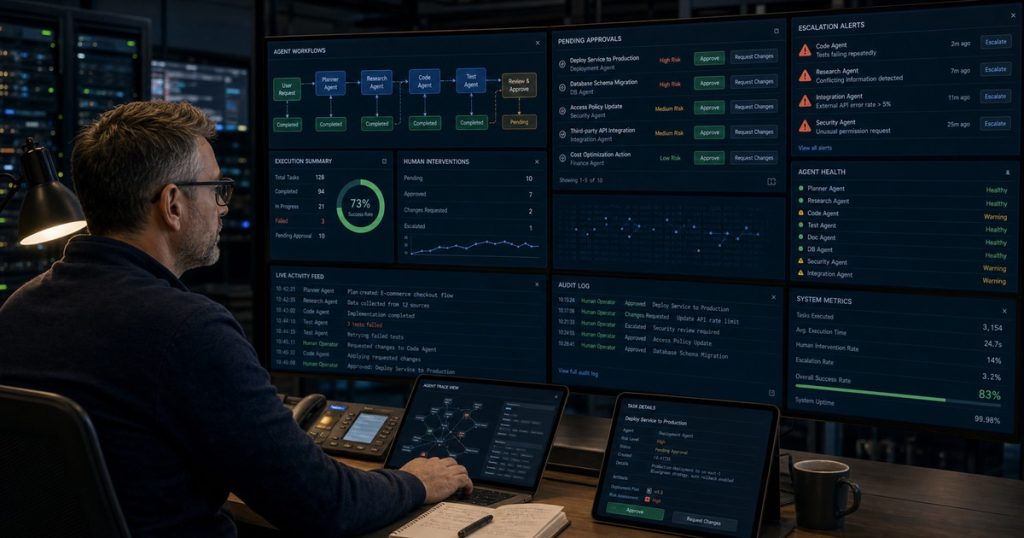
Our Vietnamese team in Ho Chi Minh City built a custom operator dashboard for this. It shows:
- The agent's reasoning chain
- All relevant context (transaction history, customer profile, past interactions)
- A clear "Approve / Reject / Escalate" button
- A text box for operator notes that get fed back into the agent's context
Here's the core of the state machine:
python
import redis
import json
from enum import Enum

class WorkflowState(Enum):
    INITIATED = "initiated"
    AGENT_PROCESSING = "agent_processing"
    AWAITING_HUMAN = "awaiting_human"
    HUMAN_APPROVED = "human_approved"
    HUMAN_REJECTED = "human_rejected"
    COMPLETED = "completed"
    FAILED = "failed"

class HumanInLoopOrchestrator:
    def __init__(self, redis_client: redis.Redis):
        self.redis = redis_client
        self.timeout = 300  # 5 minutes max for human response

    def pause_for_human(self, workflow_id: str, context: dict):
        state = {
            "workflow_id": workflow_id,
            "state": WorkflowState.AWAITING_HUMAN.value,
            "context": context,
            "created_at": time.time(),
            "ttl": self.timeout
        }
        self.redis.setex(
            f"workflow:{workflow_id}",
            self.timeout,
            json.dumps(state)
        )
        # Push to operator queue
        self.redis.lpush("human_decision_queue", json.dumps({
            "workflow_id": workflow_id,
            "summary": context.get("summary"),
            "priority": context.get("risk_score", 0.5)
        }))

    def resume_after_human(self, workflow_id: str, decision: dict):
        state = self.redis.get(f"workflow:{workflow_id}")
        if not state:
            raise ValueError("Workflow expired or not found")
        state = json.loads(state)
        state["state"] = WorkflowState.HUMAN_APPROVED.value if decision["approved"] else WorkflowState.HUMAN_REJECTED.value
        state["human_notes"] = decision.get("notes", "")
        self.redis.set(f"workflow:{workflow_id}", json.dumps(state))
        # Trigger agent resume
        self.redis.publish(f"agent_resume:{workflow_id}", json.dumps(decision))
The key insight? Every human decision is logged and fed back into the training loop. After 500 human reviews, our Tier 2 classification accuracy went from 68% to 94%. The agents learned which patterns the humans rejected.
The Numbers That Matter
We deployed this system for a fintech client processing 50,000 transactions per day. Here's what we saw in the first 30 days:
- 73% reduction in false positive fraud flags (agents were too aggressive)
- 41% faster resolution time for Tier 2 decisions (humans had clear context)
- 0 critical errors from the agent system (humans caught every edge case)
- 2.1 seconds average latency added for Tier 2 decisions (acceptable for their SLA)
But here's the stat that surprised everyone: only 8% of all decisions required human intervention. The agents handled 92% autonomously. That's the sweet spot.
More importantly, the human operators reported feeling in control. They weren't just watching a black box. They could override, explain, and improve the system.
When to Skip the Human
Not every system needs human-in-the-loop. If you're building an internal tool that summarizes Jira tickets, let the agents run wild. If you're processing non-sensitive data at low volume, automate everything.
But if your system touches money, personal data, or customer relationships, you need a human operator. It's not a weakness. It's a feature.
Actually, I'd argue it's the most important feature. Because when something goes wrong at 3 AM on a Saturday, you don't want an agent making decisions. You want a person who understands the business.
How We Built This with a Vietnamese Team
This whole system was built by a team of four senior engineers in Can Tho, Vietnam, working remotely with our US-based architect.
Related reading: Outsourcing Software Development: Why Smart CTOs Are Betting on Vietnam in 2025
Related reading: Why Smart CTOs Hire Vietnamese Developers: A Data-Driven Guide to Vietnam Tech Talent