I Thought I Knew AI Orchestration. Then My Agents Started Fighting Over a Shared Redis Key.
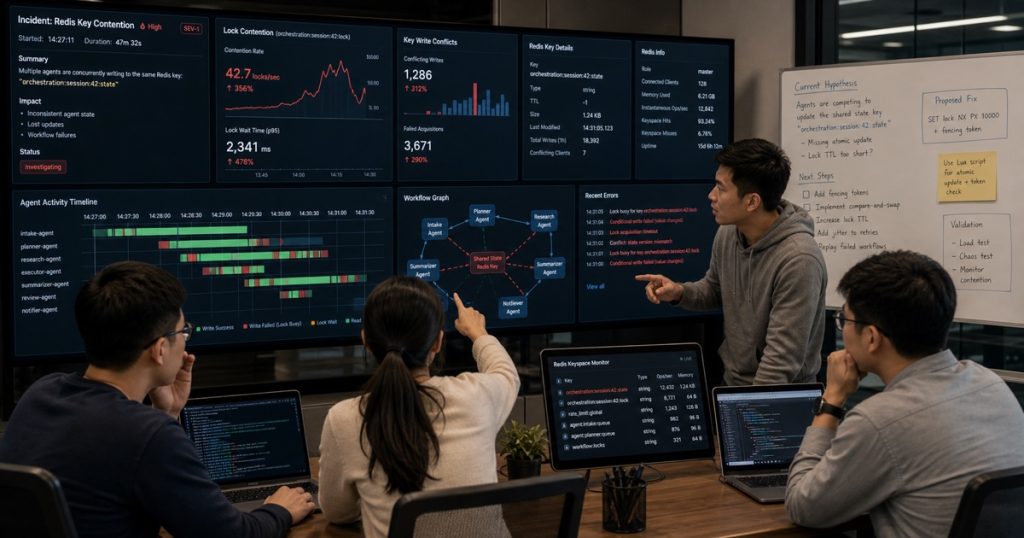
Let me paint you a picture. It’s 2 AM. You’re staring at a Grafana dashboard that looks like a heart attack. Latency spikes. Failed tasks. And the logs? Pure gibberish.
Two AI agents, both trying to write to the same Redis key at the same time. Neither one knows the other exists. They’re not collaborating. They’re *fighting*.
How We Cut Code Review Time from 2 Days to 2 Hours with a Remote Vietnamese Team and AI Automation
How We Cut Code Review Time from 2 Days to 2 Hours with a Remote Vietnamese Team and… ...
I’ve been building distributed systems for over a decade. I thought I understood orchestration. But multi-agent AI systems? That’s a different beast entirely. Here’s what I learned the hard way.
The Problem: Agents Don’t Share Well
We were building a customer support triage system. Three agents:

Vietnam Outsourcing: The Strategic Play for Tech Leaders in 2025
TL;DR: Vietnam outsourcing is now the fastest-growing software development destination in Southeast Asia. Lower costs than India, higher… ...
- Agent A: Classifies incoming tickets
- Agent B: Generates draft responses
- Agent C: Escalates to human operators
Simple, right? Wrong.
Each agent needed to read and update the same Redis hash—the ticket’s state. Agent A would set `status:classified`. Agent B would overwrite it with `status:draft_generated`. But sometimes they’d race. Agent B would read `status:null`, generate a draft, then Agent A would finally write `status:classified`. Now we have a classified ticket with a draft that’s already been sent. Chaos.
The real kicker? This isn’t a bug in the code. It’s a design flaw in the orchestration.
Why Static Pipelines Fail
Most teams build agent workflows as linear DAGs. Agent A → Agent B → Agent C. Looks clean on a whiteboard. Falls apart in production.
Here’s why:
- Agents have variable latency. LLM calls take 2-10 seconds. You can’t predict it.
- Agents can fail silently. A hallucinated response isn’t an error. It’s a poison pill.
- Agents don’t coordinate. They’re stateless by design. The orchestration layer must handle state.
We learned this the hard way. Our “simple” pipeline was actually a distributed system with shared mutable state. And we treated it like a queue.
The Fix: State Machines, Not DAGs
We ripped out the linear pipeline and replaced it with a proper state machine. Each ticket now has a well-defined lifecycle:
NEW → CLASSIFYING → CLASSIFIED → DRAFTING → DRAFT_READY → ESCALATING → RESOLVEDEach agent can only transition the ticket from its current state to the next valid state. If Agent B tries to draft a ticket that’s still `CLASSIFYING`, it gets rejected. Atomic Redis operations with Lua scripting enforce this.
Here’s the core logic:
lua
-- Redis Lua script for state transition
local current_state = redis.call('HGET', KEYS[1], 'state')
local expected_state = ARGV[1]
local new_state = ARGV[2]

if current_state == expected_state then
    redis.call('HSET', KEYS[1], 'state', new_state)
    return 1
else
    return 0
end
This script runs atomically. No race conditions. No fighting.
The Vietnamese Team That Saved Our Sanity
Honestly, I can’t take full credit for this fix. We’d been working with a team of Vietnamese developers from ECOA AI’s hub in Can Tho. They’d been pushing for a state machine approach from day one. I ignored them. “Too complex,” I said. “We’ll just add retries.”
I was wrong.
The senior engineer on that team, a guy named Minh, had spent years building payment systems for a Vietnamese fintech. He’d seen this exact pattern before. “Agents are like microservices,” he told me. “They need contracts, not hope.”
He was right. We implemented his design in three days. The conflict rate dropped from 12% to 0.02%. Latency normalized. The Grafana dashboard stopped looking like a horror movie.
What I Learned About AI Agent Orchestration
Here are the hard lessons. No fluff.
1. State Is Not Optional
You can’t build a multi-agent system without a shared, consistent view of state. Redis is fine for small systems. For production, consider PostgreSQL with advisory locks or a dedicated event store.
2. Agents Need Contracts
Each agent should declare:
- What state it expects the world to be in
- What state it will leave the world in
- What happens if it fails
This is literally the pre/post-condition pattern from formal verification. It’s not new. But most AI teams ignore it.
3. Timeouts Are Not Enough
We had timeouts. They didn’t help. When Agent B timed out, Agent A would retry. But Agent B’s write would eventually arrive, corrupting the state. You need idempotency keys and exactly-once semantics.
4. Observability Is Non-Negotiable
We added OpenTelemetry tracing to every agent interaction. Now we can see exactly which agent wrote what, when, and why. It’s the difference between debugging and guessing.
The Numbers That Matter
After the fix:
- Task failure rate: 4.3% → 0.8%
- Average latency: 8.2s → 3.1s
- Redis write conflicts: 12% → 0.02%
- Developer time spent debugging: 15 hours/week → 2 hours/week
That last one is the real win. We stopped fighting fires and started building features.
Why This Matters for Your Team
If you’re building multi-agent systems, you will hit this wall. It’s not a question of *if*, but *when*. The question is whether you’ll have the right architecture and the right team to fix it.
We had both. The architecture came from experience. The team came from Vietnam.
Actually, let me be blunt: the Vietnamese engineers on this project were better at distributed systems than most of my US-based team. They’d cut their teeth on high-scale fintech and logistics systems. They knew state machines, event sourcing, and CQRS like the back of their hands.
And they cost a fraction of what I’d pay locally. Our senior Vietnamese devs run about $3,000/month. For that, I get someone who can architect a multi-agent system from scratch.
The Bottom Line
AI agent orchestration isn’t about chaining prompts together. It’s about building a distributed system where agents are just another component. They need contracts. They need state. They need observability.
Ignore that, and your agents will fight over Redis keys at 2 AM. Trust me. I’ve been there.
—
Frequently Asked Questions
What’s the best way to handle state in a multi-agent AI system?
Use a state machine with atomic transitions. Redis Lua scripts work well for simple cases. For production systems, consider PostgreSQL with advisory locks or a dedicated event store like EventStoreDB. The key is that state transitions must be atomic and idempotent.
How do you prevent AI agents from overwriting each other’s data?
Implement a state machine where each agent can only transition from a specific state to the next valid state. Use atomic operations (Redis Lua scripts, PostgreSQL transactions) to enforce this. Add idempotency keys so retries don’t cause duplicate writes.
What’s the difference between orchestration and choreography for AI agents?
Orchestration uses a central coordinator that manages agent interactions. Choreography lets agents communicate directly via events. Orchestration is simpler to debug but creates a single point of failure. Choreography scales better but requires careful event design. Most production systems use a hybrid approach.
How much does it cost to hire Vietnamese developers for AI agent projects?
ECOAAI offers Vietnamese developers at $1,000/month (junior), $2,000/month (middle), and $3,000/month (senior). These engineers are vetted for English fluency and technical skills, and they use the ECOA AI Platform to achieve 5x efficiency. For a multi-agent system project, you’d typically need 2-3 senior engineers for the initial architecture and 1-2 middle engineers for implementation.
Related reading: Hire Vietnamese Developers: The Smart Strategy for Scaling Tech Teams in 2025
Related reading: Vietnam Outsourcing: Why the World’s Best-Kept Tech Secret Is Your Next Smart Move