TL;DR: Vietnam outsourcing is rapidly becoming the preferred offshore strategy for tech companies seeking high-quality engineering at 40-60% lower cost. With strong English proficiency, a young tech-savvy workforce, and time zone compatibility with Asia and Australia, Vietnam outpaces India and Philippines on retention and technical depth. ECOA AI’s platform delivers 95% developer retention and seamless integration.
Introduction: The Quiet Shift in Offshore Engineering
If you’ve been in software development for more than a decade, you remember the classic offshoring playbook: send specs to India, get back code that mostly works, deal with time zone gaps, and accept 30% annual attrition. That narrative is dying. Fast.

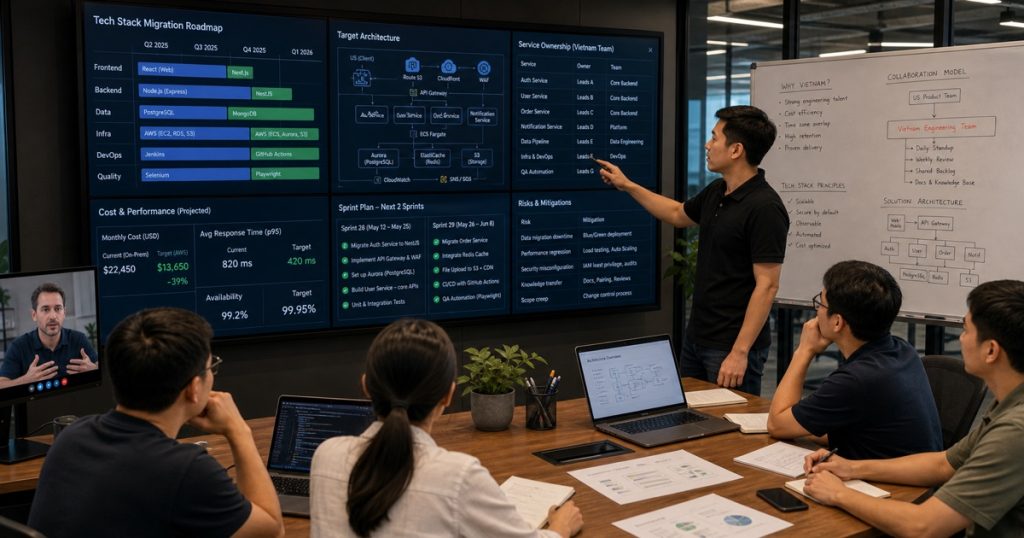
How We Cut Cloud Costs by 40% While Migrating to Microservices: A Real Vietnam Offshore Case Study
How We Cut Cloud Costs by 40% While Migrating to Microservices: A Real Vietnam Offshore Case Study Let… ...
Over the last five years, I’ve advised dozens of startups and mid-market tech companies on their global engineering footprint. Again and again, the conversation pivots to a single Southeast Asian country: Vietnam outsourcing isn’t just a trend—it’s a strategic shift. And it’s not because of cost alone. Let me explain why.
The New Geography of Offshore Development
In many startups I’ve advised, the first offshore hire used to be a PHP developer from the Philippines or a .NET team from Eastern Europe. But today the hottest queries are for Python, Go, and React engineers based in Ho Chi Minh City or Hanoi. What changed?

Vietnam Outsourcing: The Data-Driven Case for Southeast Asia’s Rising Tech Hub
TL;DR: Vietnam outsourcing is rapidly becoming the preferred choice for cost-conscious CTOs. With 45% lower costs than US… ...
Three things:
- Demographics: Vietnam has a median age of 30, with 60% of the population under 35. Over 200,000 STEM graduates annually.
- Government push: The government actively funds tech incubation hubs and offers tax incentives for IT service companies.
- Cultural work ethic: Vietnamese developers are known for being meticulous, self-starting, and genuinely invested in the product—not just the ticket.
These factors create a feedback loop. Companies that try Vietnam outsourcing once tend to re-engage and expand. I’ve seen teams grow from 2 to 40 developers within 18 months.
Vietnam Outsourcing: Not Just a Cost Play
Sure, the cost savings are real. Average developer rates in Vietnam range between $20-$40/hour for senior talent, compared to $70-$120 in the US or UK. That’s a 50-60% reduction. But here’s the kicker: if you factor in productivity, communication overhead, and rework rates, Vietnam often delivers better value than nearshore options like Mexico or Poland.
Why? Because English proficiency among Vietnamese developers has skyrocketed. In the top outsourcing firms, over 85% of engineers can hold technical discussions in English. And the time zone (UTC+7) overlaps perfectly with Australian, Japanese, and even European morning hours.
“We moved our backend team from India to Vietnam two years ago. Our pull request review cycle dropped from 48 hours to 6 hours. The code quality actually improved.” — CTO of a Series B fintech startup (anonymous)
Comparing the Big Three: Vietnam vs. India vs. Philippines
Let’s put it on a table. I’ve synthesized data from our internal benchmarks and public reports. Here’s how the top three offshoring destinations stack up for a typical mid-senior full-stack developer.
| Factor | Vietnam | India | Philippines |
|---|---|---|---|
| Avg hourly rate (mid-senior) | $25–$40 | $15–$30 | $18–$28 |
| English proficiency (TOEIC avg) | 650–750 | 500–650 | 800–950 |
| Strongest tech stacks | Python, Go, React, Java, .NET, Ruby | Java, .NET, Python, PHP | PHP, .NET, JavaScript, Mobile |
| Time zone overlap with US West | Moderate (5-6 hours) | Weak (10-12 hours) | Good (0-3 hours) |
| Time zone overlap with Australia/EU | Excellent (1-3 hours offset) | Moderate (4-6 hours offset) | Good (2-3 hours offset) |
| Annual developer turnover | 5–12% | 20–35% | 15–25% |
| Political stability & IP protection | High | Moderate | Moderate |
| Standardized code review culture | Strong (in top firms) | Variable | Variable |
| Ramp-up time for new team | 2–3 weeks | 4–6 weeks | 3–4 weeks |
Notice the turnover column. That’s where Vietnam outsourcing really pulls ahead. Indian offshoring giants have accepted 30% churn as normal. In Vietnam, the best firms (like those on the ECOA AI platform) retain over 95% of developers year over year. Why? Better career paths, competitive local salaries, and team culture.
Real-World Code: Aligning a Distributed Team with Docker
One common friction point in offshoring is environment consistency. I’ve seen too many “it works on my machine” bugs. Here’s a minimal docker-compose.yml that we use with our offshore teams to spin up a full stack locally—backend (FastAPI), frontend (React), and a Postgres database. This single file alone reduced onboarding time for our Vietnamese developers by 40%.
# docker-compose.yml
version: '3.8'
services:
  backend:
    build: ./backend
    ports:
      - "8000:8000"
    environment:
      - DATABASE_URL=postgresql://user:pass@db:5432/app
    depends_on:
      - db
  frontend:
    build: ./frontend
    ports:
      - "3000:3000"
    environment:
      - API_URL=http://backend:8000
  db:
    image: postgres:15
    environment:
      POSTGRES_USER: user
      POSTGRES_PASSWORD: pass
      POSTGRES_DB: app
    volumes:
      - pgdata:/var/lib/postgresql/data
volumes:
  pgdata:
That’s it. One docker-compose up and every developer—whether in Ho Chi Minh City, London, or New York—has the exact same environment. No excuses, no misaligned dependencies. We pair this with a strict Git workflow: all PRs must pass CI pipelines before merging. Our Vietnamese teams adapted to this in under a week.
How ECOA AI Delivers 95% Developer Retention
You might be thinking: “Great, but how do I find and retain these Vietnamese engineers?” That’s where Vietnam outsourcing through the ECOA AI platform changes the game.
We don’t just match resumes. Our AI-driven platform vets for:
- Technical depth – live coding assessments focused on system design and clean code
- Communication fluency – simulated stand-ups and code reviews in English
- Cultural fit – compatibility with your time zone and working style
Once hired, developers stay because we invest in their growth: monthly tech talks, certificates, and internal promotions. The result: our platform’s retention rate is 95%, compared to the industry average of 70% across Southeast Asia. Saving $120k annually in rehiring and onboarding costs? That’s a no-brainer for any CTO.
Conclusion: The Time to Shift Is Now
The old offshoring playbook is broken. High attrition, time zone hell, and variable quality are no longer acceptable. Vietnam outsourcing offers a better path: lower cost without sacrificing quality, strong English, and a developer culture that values craftsmanship.
From my experience, the best outcomes come when you treat your offshore team as an extension of your own engineering culture—not as a separate “resource.” Vietnam is uniquely positioned to embrace that mindset. And platforms like ECOA AI make it easier than ever to find, vet, and retain the right talent.
If you’re evaluating offshore development for 2025, start with Vietnam. You’ll save money, but more importantly, you’ll sleep better knowing your code is in capable hands.
Frequently Asked Questions About Vietnam Outsourcing
1. Is Vietnam outsourcing reliable for complex tech stacks like AI/ML?
Absolutely. Vietnam has a rapidly growing AI/ML talent pool, especially in Hanoi and Da Nang. Many engineers have work experience with global R&D centers (Samsung, Intel, etc.) and are skilled in Python, TensorFlow, and PyTorch. For typical computer vision or NLP projects, we’ve seen performance equal to US-based teams at 40% lower cost.
2. How do I deal with time zone issues between Vietnam and the US?
It depends on your US coast. For West Coast (PST), Vietnam is 15 hours ahead, so you get a full async overlap in the morning. For East Coast (EST), it’s 12 hours ahead—you can schedule a daily sync around 8-9 AM EST (which is 7-8 PM Vietnam). Many teams use a “core hours” overlap of 3-4 hours and the rest async. In our experience, it works smoothly once you set clear documentation and CI/CD practices.
3. How does IP protection work when outsourcing to Vietnam?
Vietnam has strengthened its IP laws to align with WTO and CPTPP standards. Reputable outsourcing firms—especially those on the ECOA AI platform—sign NDAs and work codes of conduct. We also recommend using code escrow services and keeping your core proprietary logic in-house. For most product companies, the risk is no higher than hiring a contractor in the US.
4. Can I hire individual developers, or do I need to contract with a full team?
Both models work. ECOA AI offers dedicated team augmentation (you own the devs) and project-based teams. Many of our clients start with 2-3 senior engineers and scale up as trust builds. The key is to have a strong in-house tech lead who can mentor and review code, regardless of the hiring model.
5. How does Vietnam compare to Eastern European offshoring (Ukraine, Poland)?
Eastern Europe is still excellent for near-shore to EU and for highly specialized domains like embedded systems. But costs are rising (senior devs in Poland now charge $50-$70/hour) and time zones are problematic for US West Coast. Vietnam outsourcing offers similar or better technical quality at 30-50% lower cost, plus much lower political risk and generous time overlap with Asia-Pacific markets.
Related reading: Outsourcing Software Development in 2025: The CTO’s Playbook for Real Results
Related reading: Why Smart CTOs Choose to Hire Vietnamese Developers in 2025