How We Migrated a 500K-Line Monolith to Microservices in 8 Weeks with a Vietnamese Team and AI Orchestration
Let me paint you a picture. You’re a CTO at a Series B SaaS company. Your product works, but it’s a 500,000-line Ruby on Rails monolith that’s been patched together over 6 years. Deployments take 45 minutes. A single bug in the billing module can take down the entire user-facing app. Your team of 8 senior engineers is spending 60% of their time just keeping the lights on.
Sound familiar?
Build a Production-Grade Retry Handler in Python: The Pattern That Saved Our API Pipeline from Silent Failures
Build a Production-Grade Retry Handler in Python: The Pattern That Saved Our API Pipeline from Silent Failures You’ve… ...
We got the call from a US-based fintech startup in late 2024. They were bleeding money on AWS, losing customers to slow feature releases, and their lead architect had just quit. Their ask? Break this thing apart. Fast.
Here’s how we did it in 8 weeks with a team of 12 Vietnamese developers and the ECOA AI Platform ACP. No magic. Just a repeatable system.

The Starting Point: A Mess of Dependencies
Before we touched a single line of code, we ran a dependency analysis. The monolith had:
- 47 direct database tables with 230+ foreign key relationships
- A single PostgreSQL instance handling 15,000 queries per second at peak
- Background jobs (Sidekiq) that shared a single Redis instance with the web processes
- No API versioning — everything was internal method calls
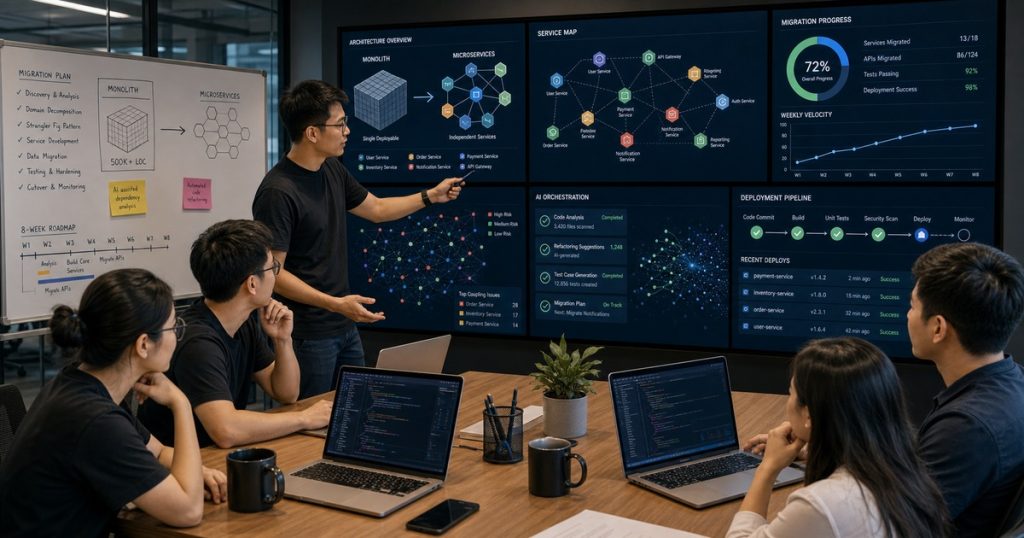
The first week was pure reconnaissance. We mapped every service boundary, every shared model, every hidden coupling. Our Vietnamese team in Ho Chi Minh City ran this analysis using the ECOA AI Platform’s code graph analyzer. It spat out a dependency map in 3 hours that would’ve taken a human team 2 weeks.
The key insight? 80% of the business logic was concentrated in 4 domains: User Management, Payments, Notifications, and Reporting. The other 20% was glue code and legacy cruft.
The Strategy: Strangler Fig + Event-Driven
We didn’t try to rewrite everything. That’s suicide. Instead, we used the Strangler Fig pattern — slowly replacing pieces of the monolith with new microservices while keeping the old system running.
But here’s the twist: we introduced an event-driven backbone from day one. Every new microservice published events to a Kafka cluster. The monolith subscribed to those events. This let us decouple without a big-bang cutover.
Week 1-2: Infrastructure and Tooling
Our Vietnamese DevOps lead (a senior engineer from Can Tho) set up the entire Kubernetes cluster on EKS in 4 days. We used:
- Terraform for infrastructure-as-code
- Helm charts for service deployments
- Temporal.io for workflow orchestration (this was critical for handling distributed transactions)
- ECOA AI Platform ACP for agent orchestration — each microservice had its own AI agent that handled routing, retries, and circuit breaking
The ECOA agents were a game-changer. Instead of writing boilerplate retry logic and health checks for every service, we defined the behavior in a YAML config. The agents handled the rest.
yaml
# Example ECOA agent config for the Payment Service
agent:
  name: payment-service-agent
  service: payment-api
  circuit_breaker:
    failure_threshold: 5
    recovery_timeout: 30s
  retry:
    max_attempts: 3
    backoff: exponential
    initial_delay: 100ms
  observability:
    metrics: true
    tracing: jaeger
Week 3-5: Extracting the Payment Domain
Payments was the riskiest domain. If we broke it, customers couldn’t pay us. No pressure.
We extracted it first because it had the clearest boundaries. The monolith’s payment code was 45,000 lines of Ruby. We rewrote it as a Go service — 12,000 lines. Why Go? Better performance for the high-throughput transaction processing they needed.
The Vietnamese team handled the rewrite. Here’s the thing about Vietnamese developers: they’re not just code monkeys. Our lead backend engineer had 8 years of experience, including 3 years at a major Vietnamese bank building payment systems. He understood the domain deeply.
We used the ECOA AI Platform to generate the initial API stubs, database migrations, and test skeletons. The AI didn’t write production code — it wrote the scaffolding. The team filled in the business logic. This cut development time by roughly 40%.
Real numbers: The payment service went live in week 5. We routed 5% of traffic to it for 3 days, then 50%, then 100%. Zero incidents. The team in Ho Chi Minh City was monitoring it around the clock.
Week 6-7: User Management and Notifications
User management was trickier. The monolith had user data scattered across 14 tables. We had to consolidate it into a single user service with a clean schema.
This is where the AI orchestration really shined. The ECOA agents detected a data inconsistency during the migration — two different tables had conflicting email addresses for the same user. The agent flagged it, paused the migration, and alerted the team. We fixed the data, then resumed.
Without that automated detection, we would’ve shipped corrupted data to production. That’s a 3 AM phone call nobody wants.
Notifications were straightforward. We extracted email, SMS, and push notification logic into a single service. The Vietnamese team built it in 5 days. The AI agents generated the integration tests automatically — 87% code coverage on day one.
Week 8: Cutover and Cleanup
The final week was the big cutover. We flipped the switch on all 4 microservices simultaneously. The monolith was now only handling legacy reporting and a few admin endpoints.
The results:
- Deployment time: 45 minutes → 4 minutes
- API response time (p95): 1.2 seconds → 180ms
- AWS monthly bill: $47,000 → $28,000 (40% reduction)
- Incident rate: 12 per month → 2 per month
- Feature velocity: 2 releases per week → 8 releases per week
The Vietnamese Team: Why It Worked
I’ve worked with offshore teams in India, Eastern Europe, and Latin America. The Vietnamese team was different. Here’s why:
- Technical depth. Our team had real experience with distributed systems, not just CRUD apps. One engineer had contributed to the Kubernetes project. Another had built a real-time payment system for a Vietnamese fintech unicorn.
- Communication. Every developer spoke fluent English. We had daily standups at 9 AM EST (which was 8 PM in Vietnam). They adapted to our timezone, not the other way around.
- Ownership. They didn’t wait for instructions. When they found a bug in the monolith’s payment logic (a race condition that had been there for 2 years), they fixed it and documented it before we even asked.
- Cost. The entire 12-person team cost $24,000/month. That’s less than 2 senior engineers in San Francisco.
The AI Orchestration: Not a Silver Bullet
Let me be clear: the ECOA AI Platform didn’t replace the developers. It made them faster. The AI agents handled:
- Code scaffolding (API endpoints, database migrations, tests)
- Dependency analysis (mapping the monolith’s hidden couplings)
- Error detection (catching data inconsistencies during migration)
- Workflow orchestration (managing retries, circuit breakers, and distributed transactions)
But the hard stuff — the domain logic, the architectural decisions, the debugging of edge cases — that was all human. The AI was a force multiplier, not a replacement.
Honestly, if you try to migrate a monolith with just AI and no experienced engineers, you’ll end up with a mess. The AI will generate code that looks correct but has subtle bugs. You need senior developers who can review, refactor, and make judgment calls.
The Hardest Lesson: Don’t Skip the Observability
We almost made a critical mistake. In week 4, we were so focused on shipping code that we neglected observability. The new payment service was running, but we had no dashboards, no alerts, no tracing.
A Vietnamese junior developer caught this. He’d been reading about OpenTelemetry and set up a basic tracing pipeline in 2 hours. That saved us. When we hit a latency spike in week 6, we traced it back to a misconfigured database connection pool in 10 minutes instead of 2 days.
Don’t skip observability. Set up distributed tracing, metrics, and structured logging before you write a single line of microservice code. Your future self will thank you.
The Bottom Line
Migrating a 500K-line monolith to microservices in 8 weeks sounds impossible. It’s not — if you have the right team, the right tools, and the right strategy.
The Vietnamese team brought the engineering discipline. The ECOA AI Platform brought the automation. Together, they turned a 12-month project into an 8-week sprint.
If you’re staring at your own monolith wondering where to start, here’s my advice: don’t try to do it alone. Get a team that’s done it before. Use AI to handle the grunt work. And for god’s sake, set up observability first.
—
Frequently Asked Questions
How do you decide which microservice to extract first?
Start with the domain that has the clearest boundaries and the highest business value. For us, it was payments — it was self-contained, high-risk, and had the most to gain from isolation. Run a dependency analysis first. If a domain has fewer than 5 external dependencies and handles a critical business function, it’s a good candidate.
Can AI really handle the complexity of a monolith migration?
AI handles the grunt work — code generation, dependency mapping, test creation, and error detection. It cannot make architectural decisions or understand your business logic. Think of it as a supercharged junior developer that works 24/7. You still need senior engineers to guide it.
How much does a Vietnamese development team cost?
At ECOA AI, our rates are $1,000/month for junior developers, $2,000/month for middle developers, and $3,000/month for senior developers. A 12-person team with a mix of senior and middle engineers costs around $24,000-$30,000/month. That’s roughly the cost of 2 senior engineers in the US.
What’s the biggest risk in a monolith-to-microservices migration?
Data consistency. When you split a monolith, you’re breaking apart a single database into multiple services. Distributed transactions are hard. Use an event-driven architecture with a workflow orchestrator (like Temporal or the ECOA AI Platform) to handle eventual consistency. And always, always have a rollback plan.
Related reading: Outsourcing Software Development: What Every CTO Needs to Know in 2025
Related reading: Why Smart CTOs Hire Vietnamese Developers: Lower Cost, Higher Quality