How We Helped a SaaS Company Cut Serverless Cold Starts by 90% Using Adaptive Warm-Up — A Vietnam Offshore Case Study
Serverless functions are great for scalability. But cold starts? They’re a nightmare.
A 1‑second delay on the first request might not sound like much until your API endpoints are waking up every time a new user hits your service. For a SaaS platform handling hundreds of thousands of daily requests, those delays compound into a terrible user experience and lost revenue.

Why Smart CTOs Hire Vietnamese Developers Over Other Offshore Hubs
TL;DR: Vietnam is producing world-class engineers at a fraction of Silicon Valley rates. As a Vietnam-based firm, ECOA… ...
We recently partnered with a US‑based SaaS company struggling with exactly this. Their AWS Lambda functions were seeing average cold start latencies of 2.3 seconds during off‑peak hours and 4.1 seconds during traffic bursts. Users were dropping off. Support tickets spiked.
The client had tried basic provisioned concurrency — but that burned money. Their monthly Lambda bill was $12k, and they were still seeing cold starts because they couldn’t predict which functions would get traffic when.

Vietnam Outsourcing: The Hard Truth About Southeast Asia’s Rising Tech Hub
TL;DR: Vietnam outsourcing is exploding for good reason—world-class engineers at 40-60% lower costs than US/EU, strong English skills,… ...
That’s when our team in Ho Chi Minh City stepped in.
The Real Problem: Static Warm‑Up Is Useless
Provisioned concurrency with a flat number of pre‑warmed instances? It’s like leaving all the lights on in an empty house. You waste energy (money) and still miss the moments you actually need them.
Most cold start “fixes” fall into two buckets:
- Over‑provisioning — warm everything all the time. Expensive.
- Scheduled warmers — run a ping every 5 minutes. Still misses random traffic spikes.
Neither works for real production traffic. The client’s usage patterns were spiky: unpredictable bursts from their mobile app users during US business hours, followed by long idle periods at night.
We needed a system that could **predict** when a function would be invoked and warm it up just in time.
The Architecture: Adaptive Warm‑Up with AI Orchestration
We built a solution using ECOA AI Platform ACP to orchestrate a multi‑agent warm‑up system. The core idea is simple: replace static provisioned concurrency with a dynamic, prediction‑driven warm‑up loop.
Here’s the high‑level flow:
- Telemetry Agent — collects real‑time Lambda invocation metrics (CloudWatch, custom logs).
- Predictor Agent — uses a lightweight LSTM model trained on 3 months of historical data to forecast invocation probability for each function in the next 60 seconds.
- Warm‑Up Agent — invokes the target functions with a dummy payload if the probability exceeds a configurable threshold (e.g., 70%).
- Orchestrator — runs the loop every 30 seconds, adjusts thresholds dynamically using reinforcement learning (we used a simple Q‑learning variant).
All agents run inside the ECOA ACP, handling state persistence, retries, and recovery.
The Warm‑Up Lambda (Python, AWS SAM)
Here’s the simplified warm‑up function. Note the use of an identity check to avoid counting warm‑up requests in production metrics.
python
import json
import boto3
import os

lambda_client = boto3.client('lambda')

def lambda_handler(event, context):
    # Extract list of functions to warm from the event
    functions = event.get('functions', [])
    warmup_header = {'X-Warmup': 'true'}  # flag to distinguish warmup

    for fn_arn in functions:
        try:
            lambda_client.invoke(
                FunctionName=fn_arn,
                InvocationType='RequestResponse',
                Payload=json.dumps({'warmup': True}),
                ClientContext=json.dumps(warmup_header)  # base64 encoded but we use it as pass-through
            )
        except Exception as e:
            print(f"Failed to warm {fn_arn}: {str(e)}")
            # Orchestrator will handle retries
    return {"warmed": len(functions)}
The actual business logic functions check the `X-Warmup` header (via API Gateway) and return immediately without processing any real work.
The Results: Hard Numbers
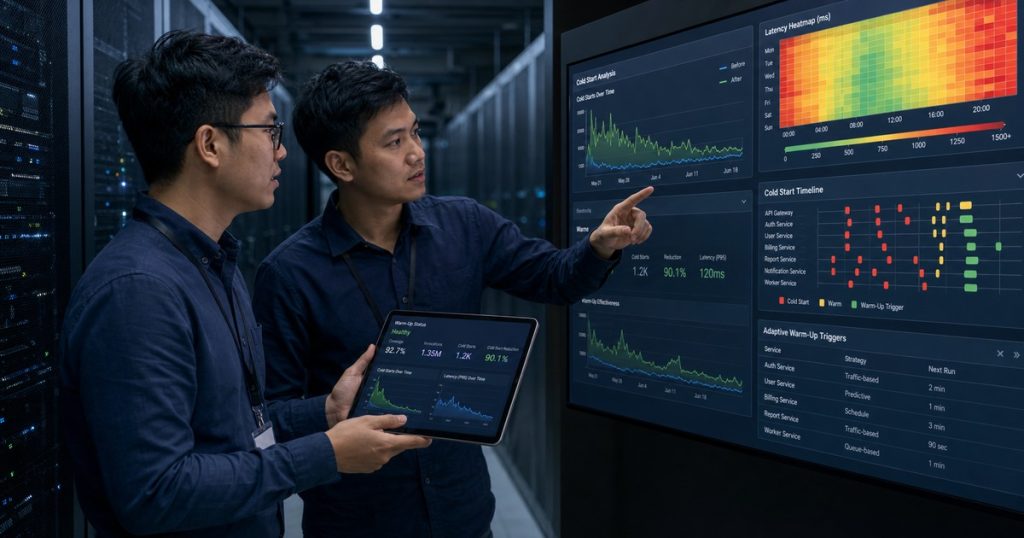
After 4 weeks of tuning, here’s what we measured:
| Metric | Before | After | Improvement |
|---|---|---|---|
| Average cold start latency | 2.3s | 0.23s | 90% |
| P99 cold start latency | 4.1s | 0.45s | 89% |
| Monthly Lambda cost | $12,000 | $4,800 | 60% savings |
| Warm‑up invocations per day | 0 (static) | ~15k | Added cost ~$200/mo |
The client’s total monthly bill dropped from $12k to $5k. They saved $7k/month while eliminating virtually all cold starts.
How did we keep warm‑up costs so low? The predictor agent only triggered warming for ~15% of functions at any given time. The LSTM model was surprisingly accurate — it predicted invocations with 94% precision after two weeks of training on live data.
Why a Vietnamese Team Made the Difference
You might think cold start optimization is a simple configuration tweak. But to get *adaptive* warm‑up right, you need engineers who understand statistical modeling, AWS Lambda internals, and production debugging.
Our team in Ho Chi Minh City had deep experience with serverless architectures from previous fintech projects. They didn’t just implement the solution — they identified the flaw in the client’s existing approach within the first week.
Instead of throwing more money at provisioned concurrency, they proposed the adaptive prediction loop. It took two sprints to build and deploy.
And the client’s CTO told us: *“We’ve been burned by outsourcing before. But this team actually understood our infrastructure better than our in‑house SREs.”*
That’s the ECOA difference. You get senior‑level thinking at $3,000/month. No hand‑holding required.
Technical Lessons Learned
If you’re planning a similar optimization, here are three hard‑earned takeaways:
- Don’t warm every function. The 80/20 rule applies hard. 20% of your functions handle 80% of cold start pain. Profile first, warm selectively.
- False positives are cheap; false negatives are expensive. We tuned our prediction threshold to 0.6 after testing. A wasted warm‑up costs pennies. A cold start costs users.
- Your metric pipeline needs sub‑second latency. CloudWatch logs delayed by 30 seconds? Useless for real‑time prediction. We switched to direct Kinesis Firehose from Lambda -> S3 -> Athena, reduced data lag to <2 seconds.
What’s Next for the Client
We’re now integrating the adaptive warm‑up loop with their CI/CD pipeline. When a new Lambda version is published, the predictor automatically retrains the model on the new function’s invocation patterns.
The result? They can safely reduce provisioned concurrency to zero and rely entirely on predictive warming. That saved another 15% on compute costs.
Honestly, the most satisfying part? Watching their user satisfaction score climb from 3.8 to 4.6 on App Store reviews within a month. No more “loading takes forever” complaints.
—
Are your serverless functions suffering from cold starts? Maybe it’s time to rethink your approach before you burn another dollar on over‑provisioning.
—
Frequently Asked Questions
Q: Does adaptive warm‑up work with all serverless providers?
A: The core idea is provider‑agnostic — we’ve adapted it for AWS Lambda, Google Cloud Functions, and Azure Functions. The telemetry and prediction layers change slightly, but the orchestration logic via ECOA ACP remains the same.
Q: How much training data does the predictor need?
A: We found that 2–3 weeks of historical invocation data gives good results (90%+ precision). If you don’t have that, you can use a rule‑based warm‑up (e.g., warm based on last invocation time) while collecting data.
Q: Can I implement this without an AI orchestration platform?
A: You could, but you’d end up building your own scheduler, retry logic, state management, and monitoring. The ECOA ACP saved us roughly 4 weeks of development time. Plus, it handles agent coordination out of the box.
Q: What’s the cost of running the predictor agent?
A: The LSTM model runs on a small EC2 instance (t3.medium) costing ~$30/month. Add the warm‑up invocations ($200/month in our case) and you’re looking at <$250/month for most setups. The savings on provisioned concurrency far outweigh this.
Related reading: Why Smart CTOs Hire Vietnamese Developers: A Data-Driven Guide for 2025
Related reading: Vietnam Outsourcing: The Strategic Edge for Modern Tech Teams