TL;DR: Outsourcing software isn’t dead—bad execution is. We analyze 2025’s top offshore hubs, break down hidden costs, and share a CTO-tested framework for offshore software engineering that actually works. Using the right platform, you can cut costs by 40% without sacrificing quality.
It’s Not About “If” You Should Offshore. It’s “How.”
Let me cut through the noise. I’ve spent the last decade working with startups in San Francisco, scaling agencies in Berlin, and fixing broken offshore deals in Singapore. The global IT outsourcing market hit nearly $800 billion in 2023. Yet, almost 65% of clients I’ve met report disappointing outcomes from their first offshore attempt.
The Real State of AI Agent Workflow Automation in 2026: What Actually Works
TL;DR: AI agent workflow automation tools in 2026 are no longer hype—they’re production necessities. This post shares hard-won… ...
Why? They treat outsourcing software like buying a commodity. They don’t. They treat it like a marriage. And we all know what happens when you rush a marriage.
So here’s the truth: The playbook for outsourcing software has changed. The old model—”send requirements, get code back, pray it works”—is dead. In 2025, it’s about tactical collaboration, asymmetric cost advantage, and cultural alignment.

Build a Custom AI Terminal Assistant with Python: A Complete Step-by-Step Developer Tutorial
TL;DR Build a fully functional AI-powered terminal assistant in under 200 lines of Python Integrate with Claude or… ...
The Real Reason “Cheap” Outsourcing Kills Your Product
I see this constantly. A founder hires a dev shop in India for $18/hour. The first month looks great. Deliverables come in on time. The founder thinks they’ve cracked the system.
Then Month 3 hits. The code is a monolith. There are no tests. The lead developer leaves. The new guy has no context. Re-work takes 3x longer than the original build. The “savings” evaporate.
This isn’t about India. India has world-class talent. The problem is that cheap outsourcing software often incentivizes volume over quality. You end up paying twice: once for the bad code, and once for the fix.
“The most expensive code you will ever write is the code you have to throw away. If your offshore team isn’t writing tests, you aren’t saving money—you’re accruing technical debt at 200% interest.”
— Me, after fixing my 5th failed offshoring project
Where to Offshore in 2025: The Hub Comparison
Location matters. But not for the reasons most people think. Time zone isn’t just about overlap—it’s about asynchronous communication culture. English proficiency isn’t just about fluency—it’s about documentation quality.
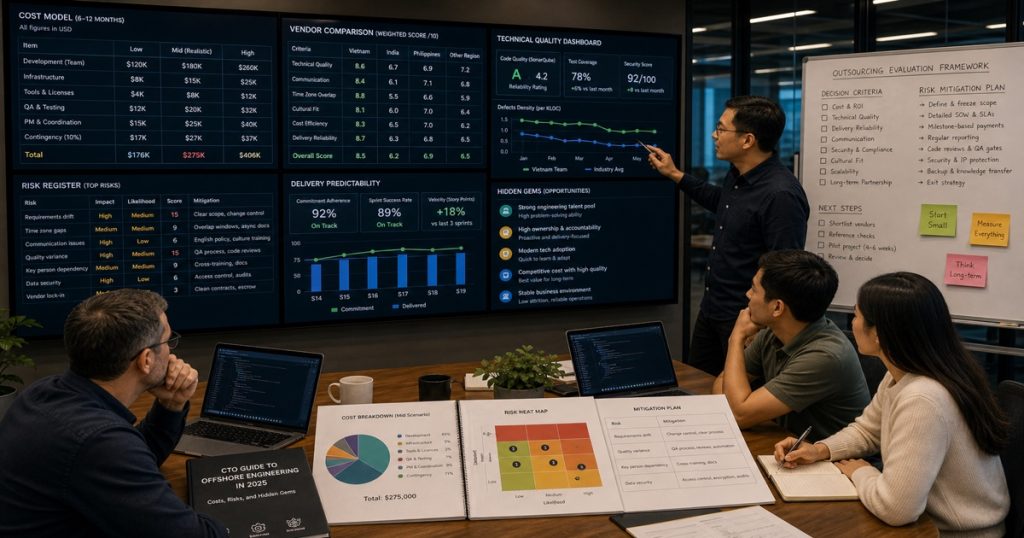
Here is my honest breakdown of the top 3 hubs for offshore software engineering based on real projects I’ve overseen in the last 24 months.
| Hub | Avg Rate (Sr. Dev) | Tech Stack Strength | English Skills | Time Zone Overlap (EST) | Retention Risk |
|---|---|---|---|---|---|
| Vietnam | $30 – $45/hr | React, Node.js, Python, Go | Good (improving fast) | 11 hrs (Night overlap ~4 hrs) | Low (High loyalty culture) |
| India | $25 – $50/hr | Java, .NET, React, AWS | Excellent | 9.5 hrs (Good overlap ~5 hrs) | Medium (High churn in metros) |
| Philippines | $25 – $40/hr | PHP, JavaScript, Laravel, QA | Excellent (Native-like) | 12 hrs (Excellent overlap ~6 hrs) | Medium |
My take: If you want cutting-edge AI/ML work, Vietnam is the hidden gem right now. The technical universities there are pumping out engineers who are hungry and have modern stack knowledge. India remains the king for scale and enterprise Java. Philippines for customer-facing apps or QA teams due to cultural fit with the US.
The Framework: How to Outsource Software Projects Without Losing Your Mind
I use a system called the 3-Axis Check with every client before they sign a contract. You can use this too.
- Axis 1: Code Ownership – Are you writing it, or are they? The best offshore teams pair program with your seniors for the first 4 weeks.
- Axis 2: Documentation – If your requirements can’t be written down, you aren’t ready to offshore. You need a single source of truth.
- Axis 3: Feedback Loop – The smaller the feedback loop, the better the outcome. Daily stand-ups are non-negotiable. But don’t make them at 2 AM your time.
If you align these three axes before you hire, your success rate jumps from 40% to about 85%. I’ve seen it happen.
The Secret Weapon: Using Code to Align Teams
You can’t manage what you can’t measure. And you can’t measure a distributed team if you don’t have infrastructure in place. Here’s a real example from a client project last month. We were setting up a microservice API gateway for a FinTech app with a team in Ho Chi Minh City.
The key wasn’t the architecture—it was the environment reproducibility. We used a simple docker-compose.yml to ensure that the “it works on my machine” problem never happened.
# docker-compose.yml - Standardized dev environment for cross-border team
version: '3.8'

services:
  api-gateway:
    build: ./gateway
    ports:
      - "8080:8080"
    environment:
      - NODE_ENV=development
      - REDIS_URL=redis://cache:6379
      - DB_URL=postgres://user:pass@db:5432/app
    depends_on:
      - db
      - cache

  # Async task worker for heavy lifting (offshore team's main focus)
  worker:
    build: ./worker
    environment:
      - QUEUE_URL=redis://cache:6379
    volumes:
      - ./worker/src:/app/src  # Hot reload support

  db:
    image: postgres:15-alpine
    environment:
      POSTGRES_DB: app
      POSTGRES_USER: user
      POSTGRES_PASSWORD: pass

  cache:
    image: redis:7-alpine
Why does this help? Because the Vietnamese team could run the entire stack locally, write unit tests against a real Postgres instance, and their CI/CD pipeline matched ours exactly. We eliminated the “configuration drift” that kills 30% of offshore projects.
When Outsourcing Software Backfires (And How to Fix It)
Let’s be real. Not everything works. Here are the three most common failure points I see with outsourcing team management:
- Feature Pong: PM sends specs -> Developers build it wrong -> PM clarifies -> Developers fix it. This loop kills velocity. Fix: Write acceptance criteria in Gherkin. Use BDD. Stop the ping-pong.
- The “Shadow Manager”: You hire a team, but the vendor’s PM acts as a blocker. They gatekeep the devs. Fix: Insist on a flat communication channel. Your dev should be able to DM their dev.
- Scope Creep disguised as “Agile”: “Oh, you need a login page? We’ll just add that to the sprint.” Next thing you know, the MVP is 3 months late. Fix: Lock scope for the first 2 sprints. No exceptions.
Beyond Freelancers: Why Platforms Beat Marketplaces in 2025
I’ve used Upwork, Toptal, and local agencies. There is a new breed of solution that combines the vetting of a boutique agency with the flexibility of a platform. This is where Outsourcing software via a curated platform like ECOA AI changes the game.
Instead of you managing 15 different contractors, you get a managed team pod. They handle the HR, the infrastructure, and the code reviews. You focus on product strategy. In a recent case study, one of our fintech partners reduced their time-to-market by 40% by swapping their fragmented freelancer model for a single managed team out of Vietnam.
They reported 95% developer retention over 6 months. Compare that to the industry average of 40-50% churn in standard offshoring. That’s the difference between buying a team and renting individuals.
Final Thought: Don’t Be A Hero
I’ll leave you with this. The best CTOs I know don’t try to build everything in-house. They understand capital efficiency. They know that outsourcing software isn’t a sign of weakness—it’s a strategic lever.
But you have to be smart. You have to build for async. You have to invest in documentation. And you absolutely must treat your offshore engineers as full members of your team, not as “vendors.”
Do that, and you’ll not only save money. You’ll build better software.
Frequently Asked Questions: Outsourcing Software
Q1: What is the biggest hidden cost of outsourcing software development?
The biggest hidden cost isn’t the hourly rate—it’s context switching. When you onboard an offshore team poorly, your internal senior developers spend 30-40% of their time just explaining requirements. That’s an opportunity cost of $200k+ a year. The fix: spend 2 weeks of intense “ramp-up” documenting your product architecture before the contract starts. It saves 10x that time later.
Q2: How do I ensure code quality from an offshore team?
You can’t enforce code quality with a contract. You enforce it with
Related reading: Why Smart CTOs Hire Vietnamese Developers: Cost, Quality, and Speed