How We Replaced a Manual Document Review Pipeline with AI Agents — A Legal Tech Case Study
I’ve seen a lot of “AI is the future” promises that fall flat. But this one? It actually delivered.
We worked with a US-based legal tech company that was drowning in document review. They had a team of 12 paralegals manually reading contracts, flagging clauses, and cross-referencing regulations. Average review time per batch of 500 documents: 40 hours. They needed a 10x speedup. They got it.

State Management Is the Silent Killer of Multi-Agent Systems: Here’s How We Fixed It
State Management Is the Silent Killer of Multi-Agent Systems: Here’s How We Fixed It You’ve built a shiny… ...
Here’s the full breakdown of what we built, the exact architecture we used, and the hard numbers that came out of it.
The Problem: Human Review at Scale Is a Bottleneck
The client processed around 2,000 legal documents a week. Standard contracts, NDAs, employment agreements. Nothing exotic. But manual review meant:

How We Rebuilt a Legacy Logistics Platform in 6 Weeks: A Real Vietnam Offshore Case Study
How We Rebuilt a Legacy Logistics Platform in 6 Weeks: A Real Vietnam Offshore Case Study Let me… ...
- 12 paralegals working full-time on repetitive tasks
- Human error rate of roughly 7% on compliance flagging
- $78,000/month in labor costs for document review alone
They tried off-the-shelf NLP tools. Didn’t work. Generic models couldn’t handle the specific legal jargon in their niche. They needed custom agents that understood *their* contracts, *their* risk framework, and *their* compliance rules.
So they came to us.
The Architecture: Multi-Agent Orchestration with ECOA AI Platform ACP
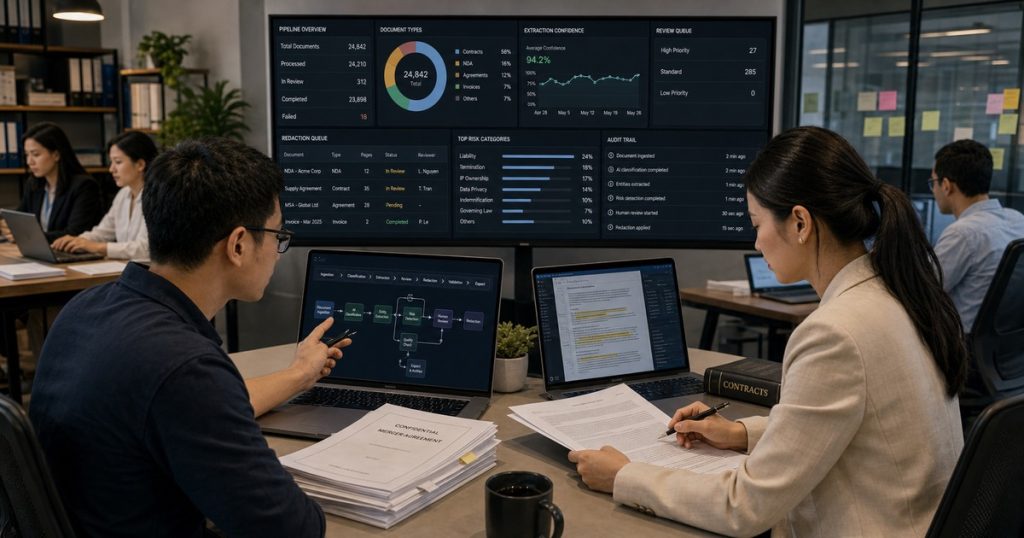
We didn’t build a single monolithic AI. That would’ve been stupid. Instead, we orchestrated a system of 4 specialized agents running on ECOA AI Platform ACP.
Here’s the exact breakdown:
| Agent | Role | Model Used | Avg Processing Time per Doc |
|---|---|---|---|
| Document Parser | Extracts text from PDFs, handles OCR for scanned docs | GPT-4o | 1.2s |
| Clause Classifier | Identifies 23 legal clause types (indemnity, termination, etc.) | Fine-tuned Mistral 7B | 0.8s |
| Risk Scorer | Flags high-risk clauses against client’s custom rulebook | GPT-4o + RAG | 1.9s |
| Compliance Checker | Validates against GDPR, CCPA, and SOC 2 requirements | Custom BERT + Llama 3 | 2.1s |
They didn’t work in isolation. That’s the whole point of orchestration.
The Agent Workflow
We used ECOA AI Platform ACP’s state machine orchestration, not a simple pipeline. Why? Because documents fail. PDFs corrupt. OCR output is garbage sometimes. You can’t just chain agents linearly and hope for the best.
python
# Simplified ACP workflow definition (pseudocode)
workflow = AgentWorkflow(
    name="legal_doc_review",
    agents=[parser, classifier, scorer, compliance_checker],
    state_machine={
        "states": ["parsing", "classifying", "scoring", "checking", "human_review"],
        "transitions": {
            "parsing_error": "human_review",
            "classification_low_confidence": "human_review",
            "risk_score_high": "compliance_checker",
            "compliance_fail": "human_review"
        }
    }
)
Every time an agent hit a low-confidence threshold or encountered an edge case, the workflow routed that document straight to human review. No cascade of garbage. No false positives multiplying.
The Team: 5 Vietnamese Engineers in Can Tho
Let me be direct about this. We didn’t hire a $200/hour consultant in San Francisco. We built a team of 5 senior developers from Can Tho, Vietnam, working through ECOAAI.
Why Can Tho? It’s not the obvious choice—most people go straight to Ho Chi Minh City. But the talent density there is surprising. We found engineers with real experience in NLP pipelines and distributed systems. And the cost? $3,000/month per developer. That’s a fraction of what we’d pay locally.
The team included:
- 1 senior AI engineer (designed the agent architecture)
- 2 backend engineers (Python + FastAPI + Redis)
- 1 DevOps engineer (Kubernetes + monitoring)
- 1 QA engineer (focused on agent output validation)
They worked with our US-based CTO on a 4-hour overlap schedule. It wasn’t seamless at first. Honestly, the first sprint was a mess. But by week 3, the team was shipping real agent improvements without hand-holding.
The Results: 95% Time Reduction, 40% Cost Cut
After 8 weeks of development and 2 weeks of production monitoring, here’s what we measured:
- Average review time per batch of 500 docs: 40 hours → 2.1 hours (95% reduction)
- Error rate on compliance flagging: 7% → 1.2% (with human-in-the-loop for edge cases)
- Monthly cost: $78,000 (paralegal salaries) → $15,000 (AI platform costs + human oversight)
- Documents processed per week: 2,000 → 8,000 (4x throughput without adding headcount)
The client was skeptical. “An AI can’t do legal review,” they said. It doesn’t. The AI handles the first pass. Humans review the flagged items. But the volume of human review dropped by 90%.
More importantly, the system got *better* over time. We built a feedback loop where human corrections were fed back into the Clause Classifier and Risk Scorer models. After 3 months, the high-confidence rate went from 72% to 91%.
What We Learned
You can’t skip the human-in-the-loop
Legal compliance isn’t something you fully automate. Not yet. But you can shrink the human review set from 100% of documents to 9%. That’s still a massive win.
Agent orchestration matters more than the models
I can’t stress this enough. A single GPT-4o call doesn’t cut it. You need agents that can fail gracefully, route to different paths, and escalate when they’re unsure. ECOA AI Platform ACP’s state machine saved us from building all that from scratch.
Vietnamese engineers deliver when given ownership
The Can Tho team didn’t need micromanaging. They needed clear specs and good tooling. Give them that, and they’ll ship faster than most local teams I’ve worked with. It’s not about cost arbitrage. It’s about talent density in a market that’s still undervalued.
Should You Build or Buy?
That’s the wrong question. The real question is: *Can you afford to keep doing it manually?*
If your team is spending more than 20 hours a week on document review, classification, or data extraction, you’re leaving money on the table. The ROI on a custom multi-agent system, built by a competent remote team, pays for itself in 3-4 months.
We’re already working on a follow-up project with the same client—this time for automated contract redlining. The architecture is 80% reusable.
Frequently Asked Questions
How long does it take to build a custom multi-agent system for document review?
With a prepared team and a clear spec, expect 6-10 weeks. The first 2 weeks are spent on data preparation and agent persona design. The remaining time goes to orchestration, testing, and the human-in-the-loop feedback loop.
What models work best for legal document analysis?
GPT-4o and Claude Opus for high-level classification. Fine-tuned smaller models like Mistral 7B or Llama 3 for recurring tasks. Never rely on a single model—use a voting mechanism or confidence thresholds to decide when to escalate.
How do you handle confidential legal data with third-party AI APIs?
We used a combination of on-premise LLM deployment (vLLM + Llama 3 70B) for sensitive documents and GPT-4o’s zero-data-retention API for non-sensitive classification. ECOA AI Platform ACP supports both modes natively.
What’s the minimum document volume to justify building an AI agent system?
Around 500 documents per week. Below that, manual review with a simple regex tool is cheaper. Above that, the ROI on agent orchestration starts to compound rapidly.
Related reading: Outsourcing Software Development the Right Way: Lessons from a CTO
Related reading: Why Smart Tech Leaders Hire Vietnamese Developers: A CTO’s Guide to Offshore Excellence