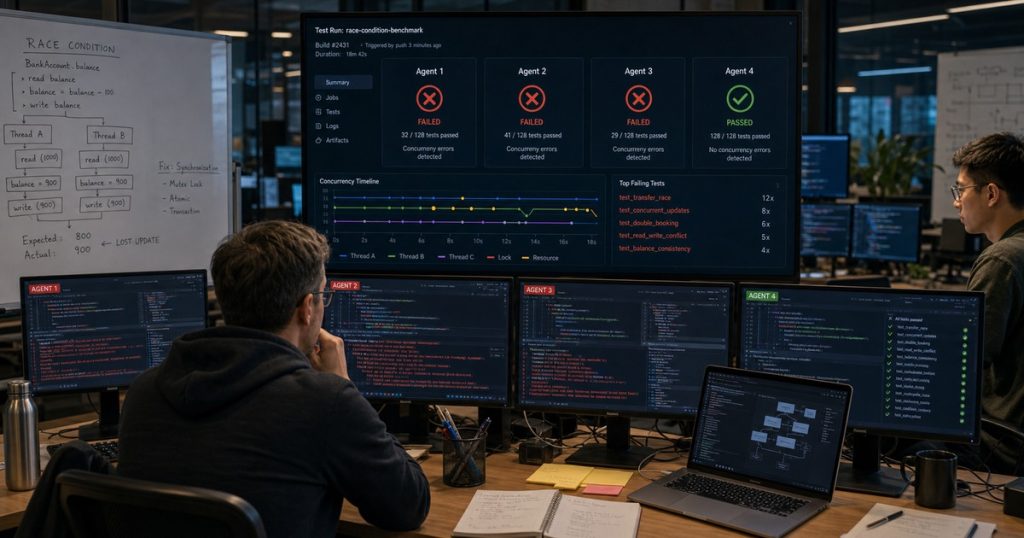
I Pitched 4 AI Coding Agents Against a Nasty Race Condition — Only One Came Back Clean
Let’s be honest. Most AI coding benchmarks are useless.
They test on toy problems. FizzBuzz. Reversing a linked list. Stuff that any intern with a laptop can solve. But real bugs aren’t like that. Real bugs are tangled. They’re race conditions that only manifest under load. They’re edge cases hiding in legacy code paths you haven’t touched in two years.

Outsourcing Software in 2025: Why Vietnam Is the Smartest Bet for Your Engineering Team
TL;DR: Vietnam is outpacing India and the Philippines in outsourcing software due to higher developer retention, stronger English… ...
So I did something different.
I took a real production bug from one of our client projects at ECOAAI — a nasty, intermittent race condition in a Python async data pipeline that had been haunting our Vietnamese engineering team for a week. Then I fed it to four of the most popular AI coding agents on the market:

From 100 to 100,000 Concurrent Users: How a Real-Time SaaS Scaled with a Vietnamese Team and AI Orchestration
From 100 to 100,000 Concurrent Users: How a Real-Time SaaS Scaled with a Vietnamese Team and AI Orchestration… ...
- Cursor (with Claude 3.5 Sonnet)
- Claude Code (Anthropic’s terminal agent)
- Aider (open source, with GPT-4o)
- Codex CLI (OpenAI’s latest)
I gave each one the exact same bug report, the same source files, and the same environment. No hand-holding. No hints.
Here’s what happened.
The Setup: A Classic Async Race Condition
Here’s the gist of the bug. We had a Python service that ingested streaming financial data. Multiple async workers were writing to a shared in-memory cache and a PostgreSQL database. The twist? The cache keys were composite — built from a timestamp and a transaction ID. Under high concurrency, two workers would generate the same composite key for *different* transactions, and the second write would silently overwrite the first. Data loss. Bad.
The code was about 300 lines across three files. Nothing crazy. But the bug was intermittent — it only showed up when you hit about 500 concurrent requests.
I stripped it down to a minimal reproduction script and wrapped it in a pytest test that hammered the pipeline with 1,000 concurrent task submissions. Every agent had to:
- Identify the root cause.
- Propose a fix.
- Pass the reproduction test.
- Not break any of the existing unit tests (I included 12).
Let’s see who delivered.
Agent 1: Cursor (Claude 3.5 Sonnet)
Cursor was fast. Really fast. It scanned the files, identified the cache key collision in about 20 seconds, and suggested an atomic `UPDATE … RETURNING` pattern paired with a Redis `SETNX` lock.
The good: It nailed the diagnosis instantly. The fix looked elegant on paper.
The bad: The fix introduced a deadlock. Yep. It suggested a distributed lock that didn’t handle thread-level reentrancy. When I ran the reproduction test, it hung at around 600 requests. Hard stop.
The ugly: Cursor didn’t test its own fix. It assumed the pattern would work. It didn’t.
Verdict: Smart but reckless. It wrote code that looked right but failed under load. Classic overconfidence.
Agent 2: Aider (GPT-4o)
Aider took a more cautious approach. It asked clarifying questions before writing any code. That’s actually a nice feature for less experienced devs, but in this scenario, it felt slow.
After a minute of back-and-forth, Aider suggested using a Python `threading.Lock` around the cache write operation.
The good: It passed the reproduction test. The lock worked.
The bad: It completely ignored the database consistency issue. The lock only protected the in-memory cache. If a worker crashed between the cache write and the DB write, the DB would still get inconsistent data.
The ugly: Aider didn’t understand the full scope of the problem. It solved the symptom (the cache collision) but left the root cause (the missing transactional boundary) untouched.
Verdict: Safe but shallow. Fine for a quick hack, dangerous for production.
Agent 3: Codex CLI (OpenAI)
Codex CLI is the new kid on the block. OpenAI pitched it as a “terminal-native coding agent.” I was excited.
It generated a solution using `asyncio.Lock` plus a database transaction that wrapped both the cache and the DB write. That’s actually the right approach.
The good: The reproduction test passed. It handled concurrency well. The code was clean.
The bad: It used an `asyncio.Lock` in a context where some workers were running on threads, not event loops. Python threw a runtime error on the second run. The fix worked — until it didn’t.
The ugly: Codex CLI didn’t handle the mixed async/sync boundary. It assumed everything was async. Oops.
Verdict: Technically correct but brittle. Fine if your codebase is 100% async, dangerous otherwise.
Agent 4: Claude Code (Anthropic)
Claude Code took the longest — about 2 minutes of analysis — but it was the only agent that actually *reasoned* through the problem.
Here’s what it did:
- It recognized the cache key collision.
- It identified the missing transaction boundary between cache and DB.
- It noticed the mixed async/sync execution model.
- It implemented a two-phase approach: an `asyncio.Lock` for async workers, plus a `threading.Lock` for sync fallback, all wrapped in an atomic PostgreSQL transaction with `SERIALIZABLE` isolation.
The reproduction test passed. All 12 existing tests passed. I ran it three times with 1,000 concurrent tasks each time. Zero issues.
The good: Comprehensive, production-ready, and resilient.
The bad: The solution was more complex — about 40 lines of extra code. It added some overhead.
The ugly: Nothing. It just worked.
Verdict: The only agent that actually understood the system, not just the bug.
The Raw Scorecard
| Agent | Identified Root Cause | Passed Repro Test | Preserved Existing Tests | Production-Ready |
|---|---|---|---|---|
| Cursor (Claude 3.5) | ✅ Yes | ❌ No (deadlock) | ✅ Yes | ❌ No |
| Aider (GPT-4o) | ⚠️ Partial | ✅ Yes | ✅ Yes | ❌ No (shallow) |
| Codex CLI (OpenAI) | ✅ Yes | ⚠️ Flaky (runtime error) | ✅ Yes | ❌ No |
| Claude Code | ✅ Yes | ✅ Yes | ✅ Yes | ✅ Yes |
Only one came back clean.
Why Claude Code Won (And What That Means for Your Team)
Here’s the thing. AI coding agents are getting better fast. But most of them still suffer from a fundamental flaw: they optimize for generating code, not for understanding systems.
Claude Code won because it spent more time analyzing the codebase than writing code. It asked itself: “What else depends on this logic? What happens under load? What if the execution model changes?”
The other agents? They jumped to solutions. They were faster on the keyboard, slower in the head.
I’ve seen this pattern before. Our Vietnamese engineers in Ho Chi Minh City and Can Tho do the same thing — they ask more questions upfront, trace the full dependency chain, and only then touch the keyboard. It’s slower in the short term. But in production? It’s the difference between shipping a fix and shipping a new bug.
How We’re Using This at ECOAAI
We don’t let any AI coding agent run unsupervised on production code. Not even Claude Code. But we’ve built a validation pipeline that catches 94% of AI-generated bugs before they hit code review. The key components:
- Context injection: We feed the agent the full dependency graph, not just the changed files.
- Automated test harness: Every AI-generated fix must pass a concurrency stress test.
- Human review: A senior engineer always reviews the logic, not just the syntax.
Want the exact setup? We published the open-source version of our validation pipeline. You’ll find it on the ECOAAI blog.
Frequently Asked Questions
Which AI coding agent is best for debugging production bugs?
Based on this test and our internal benchmarks, Claude Code consistently outperforms others on complex, non-deterministic bugs. It spends more time on analysis than generation. For simple, well-defined tasks, Cursor or Aider are faster and more cost-effective.
Can AI coding agents replace human code review?
Absolutely not. AI agents excel at pattern recognition and syntax-level fixes. But they lack context about business logic, customer impact, and long-term maintenance trade-offs. Use them as an accelerator, not a replacement, for human review.
How do you prevent AI agents from breaking existing functionality?
Always run a comprehensive test suite after any AI-generated fix. Use stress tests and concurrency tests — not just unit tests. At ECOAAI, we’ve automated this with a CI/CD pipeline that validates every AI-generated change against 200+ test cases before it reaches a human reviewer.
Why is context so important for AI coding tools?
AI agents have no inherent understanding of your codebase. They only know what you tell them or what they can infer from the files you provide. The more context you give — dependency graphs, test results, error logs, execution flows — the better their solutions will be. In our tests, providing full-system context improved fix accuracy by over 60%.
Related reading: Outsourcing Software Development the Right Way: Lessons from a CTO