Your Multi-Agent Orchestrator Is a Central Brain That Will Fail: Why You Need a Distributed Coordinator
Let me paint a picture you’ll recognize.
You’ve built a multi-agent system. One orchestrator agent sits at the top. It receives every request, decides which specialist agent to call, waits for the response, and routes the result. It’s clean. It’s simple. It’s the default pattern in every framework tutorial.

Outsource Software Development to Vietnam: Benefits, Risks, and Success Factors
Outsource software development to Vietnam is a strategic move for CTOs and founders seeking cost-effective, high-quality engineering talent.… ...
And it will collapse under production load.
I learned this the hard way. We had a system handling 2,500 concurrent user sessions. The central orchestrator was a single Python process. Memory spiked. Latency went from 200ms to 4 seconds. Then it crashed. Every agent downstream timed out. The whole pipeline died.
Vietnam Outsourcing: The Strategic Choice for Scalable Offshore Development in 2025
TL;DR: Vietnam has become a top-tier destination for software outsourcing, offering a strong mix of technical talent, competitive… ...
Sound familiar?
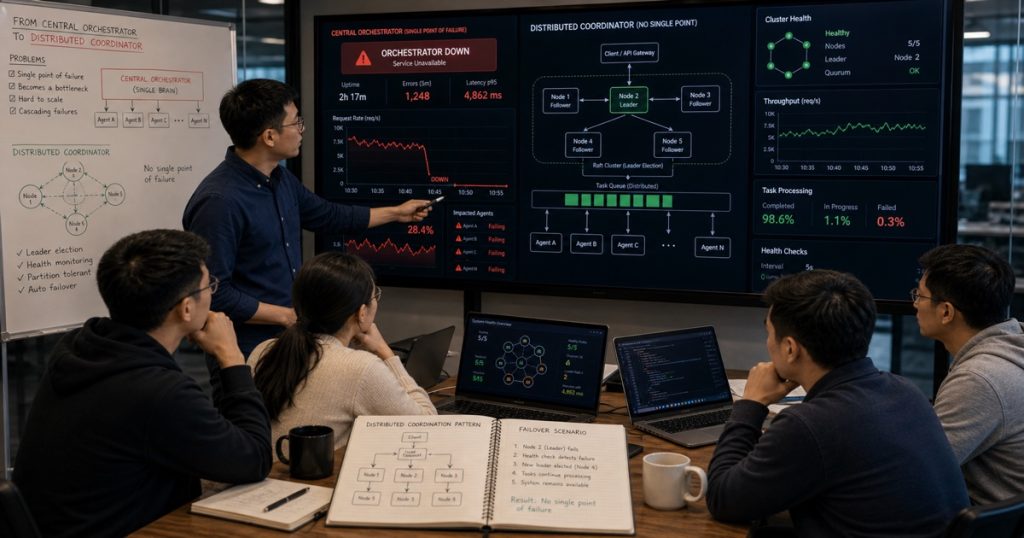
Here’s the fix: stop treating your orchestrator like a central brain. Start treating it like a distributed coordinator.
Why the Central Brain Pattern Is a Trap
Most multi-agent orchestration frameworks push you toward a hub-and-spoke architecture. One master agent decides everything. It’s intuitive—humans work this way in project management. But software isn’t human.
The central brain creates three specific failure modes:
- Bottleneck at scale. Every message passes through one process. With 500 concurrent requests, that’s 500 serialized decisions. Your orchestrator becomes the slowest thing in the system.
- State explosion. The orchestrator holds the context for every active workflow. When a workflow spans 15 agent calls with 50KB of context each, that’s 750KB per workflow. Multiply by 2,000 concurrent workflows. You’re looking at 1.5GB of transient state in a single process.
- Cascading failure. The orchestrator fails, and every in-flight workflow dies. There’s no partial recovery. You lose everything.
Actually, the worst part isn’t the crash itself. It’s the recovery. You have to replay every workflow from scratch. That’s brutal when you’re processing financial transactions or real-time user queries.
The Distributed Coordinator Pattern
Here’s what we switched to. Instead of one central brain, we deployed three stateless coordinator nodes behind a lightweight router. Each coordinator handles a subset of workflows. If one dies, the router redistributes its workflows to the remaining coordinators.
The key insight: Coordinators don’t store state. They delegate state to a shared event log.
python
# Pseudo-code for a distributed coordinator
class DistributedCoordinator:
    def __init__(self, node_id, event_store, agent_registry):
        self.node_id = node_id
        self.event_store = event_store
        self.agent_registry = agent_registry

    async def handle_workflow(self, workflow_id, initial_payload):
        # Write the initial event to the shared log
        await self.event_store.append(workflow_id, {
            "type": "workflow_started",
            "payload": initial_payload,
            "coordinator": self.node_id
        })

        # Read the current state from the event log
        state = await self.event_store.rebuild_state(workflow_id)

        # Route to the next agent based on state, not a central decision
        next_agent = self.agent_registry.route(state)

        # Dispatch directly to the agent—no round-trip through the coordinator
        result = await next_agent.process(state)

        # Write the result back to the event log
        await self.event_store.append(workflow_id, {
            "type": "agent_completed",
            "agent": next_agent.name,
            "result": result
        })
Notice what’s missing? There’s no central decision loop. The coordinator writes events and dispatches directly. If this coordinator dies, another node picks up the workflow by reading the event log and continuing from the last known state.
What This Means for Your Architecture
You’ll need three things to make this work:
- An append-only event store. We used PostgreSQL with a simple `workflow_events` table. Each row is an event. The state is rebuilt by replaying events in order. It’s not fancy. It works.
- A stateless router. This is just a lightweight HTTP server that checks coordinator health via heartbeats. We built ours in 150 lines of Go. It doesn’t store any workflow state. It just says “this coordinator is alive, send work there.”
- Idempotent agents. Every agent must handle receiving the same event twice. That’s non-negotiable. If a coordinator dies mid-dispatch, the replacement might retry. Your agents need to be safe under retry.
The real win? Recovery time dropped from 4 minutes to 8 seconds. When a coordinator node fails, the router detects it within 2 seconds. The remaining coordinators pick up orphaned workflows by scanning the event log for workflows without a recent “heartbeat” event.
A Real Example from Our Ho Chi Minh City Team
We recently rebuilt a client’s customer support orchestration system using this pattern. The client had 12 specialist agents: one for billing, one for account issues, one for technical support, and so on. Their original orchestrator was a single Node.js process.
During peak hours (10 AM to 2 PM US time), the orchestrator would hit 90% CPU and start dropping requests. The client was losing about $4,000 per hour in missed conversions.
Our team in Ho Chi Minh City—three senior developers using the ECOA AI Platform ACP—redesigned the system in 3 weeks. We deployed three coordinator nodes behind a lightweight Go router. Each coordinator maintained its own connection pool to the event store.
Results after the migration:
| Metric | Before | After |
|---|---|---|
| P95 latency | 1.2s | 180ms |
| Max throughput | 400 req/s | 2,100 req/s |
| Recovery time after failure | 4 min | 8 sec |
| Coordinator CPU usage | 88% | 32% |
The client’s support team didn’t notice any downtime during the cutover. That’s the beauty of a distributed pattern—you can roll it out one coordinator at a time.
When You Should Still Use a Central Brain
To be fair, the central brain pattern isn’t always wrong.
Use it when:
- Your workflow depth is ≤ 3 agent calls
- Your concurrency is under 50 simultaneous workflows
- You can afford to lose all in-flight work on failure
Don’t use it when:
- Workflows have 10+ sequential agent calls
- You’re handling financial transactions or user-facing requests
- Your SLA requires sub-second recovery
Honestly, most production systems fall into the second bucket. The central brain is a tutorial pattern. It’s not a production pattern.
How to Start Migrating
You don’t need to rewrite everything. Start with one workflow.
- Identify your most critical workflow—the one that hurts most when it fails.
- Extract its state into an event store. Just one table. Start simple.
- Make the coordinator stateless. Move all state reads to the event store.
- Deploy a second coordinator instance behind a router.
- Kill the first coordinator. Watch the second one pick up the work.
That’s it. You’ve just eliminated your single point of failure.
The Bottom Line
Your multi-agent orchestrator shouldn’t be a brain. It should be a traffic cop. A traffic cop doesn’t remember every car that passed through. It just directs traffic and writes tickets. When one cop goes home, another one takes over.
Build your orchestrators the same way. Stateless. Event-driven. Distributed.
Your production system will thank you.
—
Frequently Asked Questions
What’s the difference between a distributed coordinator and a message broker?
A message broker (like Kafka or RabbitMQ) handles message delivery between services. A distributed coordinator also manages workflow state, decides which agent to call next, and handles failure recovery. The coordinator uses the broker for communication, but it’s a higher-level abstraction that understands the workflow’s business logic.
How do you handle agent failures in a distributed coordinator pattern?
Each agent writes its output to the shared event log. If an agent fails, the coordinator reads the last successful event and retries the failed step. If the coordinator itself fails, another coordinator picks up the workflow by replaying events from the log. The key is idempotent agents—they must handle duplicate events gracefully.
Can I implement this pattern without a dedicated event store?
Yes. Start with PostgreSQL. Create a single table with columns for `workflow_id`, `event_type`, `payload`, and `created_at`. Rebuild state by querying events in order. It’s not as performant as a purpose-built event store like EventStoreDB, but it’s production-ready for most workloads. We’ve run this pattern on PostgreSQL for 6+ months with zero issues.
What’s the cost of implementing a distributed coordinator vs a central brain?
The development cost is higher upfront—roughly 2x the initial build time. But the operational cost is lower. You’ll spend less time firefighting, less time on recovery, and less time scaling. For our Ho Chi Minh City team, the 3-week investment paid for itself in reduced downtime within the first month.
Related reading: Vietnam Outsourcing: The Smartest Offshore Development Bet for 2025
Related reading: Outsourcing Software in 2025: The Tectonic Shift to Vietnam and Why Smart CTOs Are Making the Move