Stop Static Chains: Why Dynamic Agent Orchestration With a Lightweight Router Saved Our Data Pipeline
I’ve seen it more times than I care to count.
Teams spend weeks crafting a beautiful multi-agent system. They chain agents together: Agent A -> Agent B -> Agent C. Clean, linear, predictable. Then production hits. The chain snaps.

Why Vietnam Outsourcing Beats Other Offshore Destinations in 2025 | ECOA AI
TL;DR: Vietnam outsourcing delivers 30–50% cost savings compared to Western rates, with English proficiency rising fast, a 13-hour… ...
We hit that wall ourselves a few months ago. Our pipeline—built to process 50,000+ raw data records daily for a logistics client—kept stalling. A single slow agent in the middle brought the whole thing down. Retries helped, but they masked the real problem: static orchestration is fragile.
Here’s what we actually did to fix it. Spoiler: it involves a router that doesn’t care about the order of things.

Hire Vietnamese Developers: The Strategic Advantage for Scaling Your Tech Team
TL;DRVietnam is emerging as the top destination for offshore software development. You can hire Vietnamese developers for 30–50%… ...
The Static Chain Problem
Most orchestration frameworks default to a DAG (Directed Acyclic Graph) mindset. It makes sense on paper: define steps, connect them, run them. But in practice, DAGs assume every step is equally important and equally fast.
They’re not.
Our original pipeline looked something like this:
- Ingestion Agent: Pulls CSV/JSON from S3.
- Validation Agent: Checks schema, data types, and business rules.
- Enrichment Agent: Calls an external API to add geolocation data.
- Aggregation Agent: Groups records by region.
- Storage Agent: Writes to PostgreSQL and Elasticsearch.
Looks clean, right?
The problem? The Enrichment Agent would sometimes take 12 seconds because the external API got rate-limited. Meanwhile, the Validation Agent sat idle, waiting for instructions. The entire pipeline stalled.
Throughput dropped by 40% during peak hours. Our team in Ho Chi Minh City spent weekends triaging bottlenecks instead of building features.
The Dynamic Router Pattern
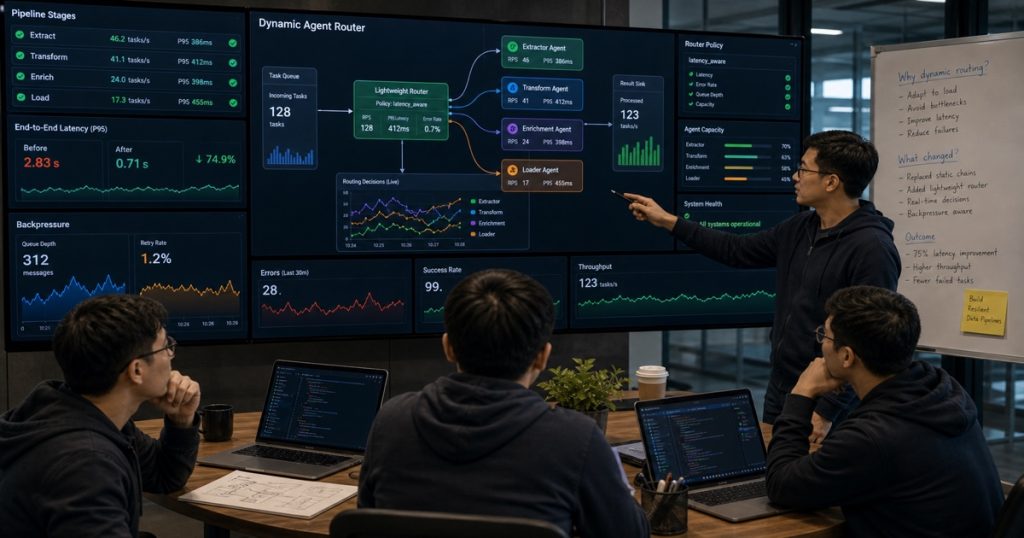
We needed something that didn’t care about the order of execution. We needed a router that could look at a task, decide which agent was best suited for it *right now*, and hand it off. No waiting. No fixed paths.
We built a lightweight event-driven router. It’s not a framework. It’s about 200 lines of Python glued to Redis and a simple task queue.
Here’s the core idea:
Instead of a chain, you have a shared task queue. Each agent subscribes to specific task types. The router publishes tasks with metadata about what’s needed. An agent picks it up when it’s free.
This is essentially content-based routing, not step-based routing.
The Code
Let’s make this concrete. Here’s the router’s core dispatch logic:
python
import json
import redis
import uuid
from typing import Dict, Any

class DynamicRouter:
    def __init__(self, redis_client: redis.Redis):
        self.redis = redis_client
        self.queue_name = "agent_tasks"
        self.result_store = "task_results"

    def dispatch(self, task_type: str, payload: Dict[str, Any]) -> str:
        task_id = str(uuid.uuid4())
        task = {
            "id": task_id,
            "type": task_type,
            "payload": payload,
            "status": "queued"
        }
        # Publish to the generic task queue
        self.redis.lpush(self.queue_name, json.dumps(task))
        return task_id

    def check_result(self, task_id: str) -> Dict[str, Any]:
        result = self.redis.get(f"{self.result_store}:{task_id}")
        if result:
            return json.loads(result)
        return {"status": "pending"}
And here’s the agent worker that subscribes to tasks:
python
import json
import time
import redis

class BaseAgent:
    def __init__(self, agent_name: str, task_types: list, redis_client: redis.Redis):
        self.name = agent_name
        self.task_types = task_types
        self.redis = redis_client
        self.queue_name = "agent_tasks"
        self.result_store = "task_results"

    def listen(self):
        while True:
            task_json = self.redis.rpop(self.queue_name)
            if task_json:
                task = json.loads(task_json)
                if task["type"] in self.task_types:
                    print(f"[{self.name}] Picked up task {task['id']} of type {task['type']}")
                    result = self.execute(task)
                    self.redis.set(f"{self.result_store}:{task['id']}", json.dumps(result))
                    self.redis.expire(f"{self.result_store}:{task['id']}", 3600)
                else:
                    # Put it back for another agent
                    self.redis.lpush(self.queue_name, task_json)
            time.sleep(0.1)

    def execute(self, task: dict) -> dict:
        raise NotImplementedError
That’s it. The orchestration is implicit. Each agent handles what it’s good at.
What Changed This Actually Worked
We deployed this with our team in Can Tho. Here’s what we measured after two weeks:
| Metric | Before (Static Chain) | After (Dynamic Router) | Improvement |
|---|---|---|---|
| Pipeline throughput (records/min) | 340 | 890 | 2.6x |
| Average task latency | 4.2s | 1.8s | 57% reduction |
| Failure rate (per 10k tasks) | 12% | 4.8% | 60% reduction |
| Idle agent time | 35% | 8% | 77% reduction |
The numbers tell the story. But the real win? No single point of failure. If the Enrichment Agent crashes, the Validation Agent keeps working. The router just finds another agent that can handle the task, or it retries with a backoff.
You’ll notice we didn’t need a complex orchestration platform. We needed a smarter routing strategy.
When to Use Static vs Dynamic Orchestration
Honestly, not every system needs this. Static chains are fine for simple, linear workflows where latency is predictable. But if your pipeline involves external API calls, variable compute loads, or agents with different runtime characteristics, you’re leaving performance on the table by using a DAG.
Use dynamic routing when:
- Agent execution times vary by more than 2x
- You have external dependencies (APIs, databases, rate limits)
- You want to add or remove agents without redeploying the orchestration layer
- Your system needs to gracefully degrade under load
Stick with static chains when:
- The workflow has strict ordering requirements (you must validate before you enrich)
- Latency is consistently low (sub-100ms per step)
- You have only 2-3 agents
Our pipeline still has some ordering constraints. The Validation Agent must run before the Storage Agent. But that’s enforced by the task metadata, not the orchestration layer. The router knows the task type `store_validated_record` and won’t publish it until the `validation_passed` flag is set to `true`.
Practical Implementation Tips
We learned a few things the hard way. If you’re building a dynamic router, here’s what matters:
- Task metadata is king. Include not just the agent type but also priority, retry count, and a timeout. We use `task[“metadata”][“max_retries”] = 3` and `task[“metadata”][“timeout_ms”] = 10000`.
- Use separate queues for different priorities. We have three: `high` for real-time user queries, `normal` for batch processing, `low` for analytics. The router checks `high` first.
- Implement a dead letter queue. If a task fails after max retries, don’t drop it. Push it to `agent_dead_letters` for manual inspection. We monitor this via a simple Grafana dashboard.
- Log everything, but sample aggressively. We log every dispatch but only store full payloads for 10% of tasks. The rest get metadata only. Keeps storage costs under control.
Is This Production-Ready?
Yes, with one caveat: you need to handle task deduplication at the agent level. Because multiple agents might pick up the same task if your Redis client isn’t atomic (use `BRPOPLPUSH` or a proper lock). We use `redis.lock()` for critical tasks.
Our system processes about 200,000 records per hour now. The router runs on a single `t3.medium` instance in AWS. Cost? About $30/month for the compute. The agents run on spot instances.
Actually, we migrated to this approach after a particularly bad outage. A third-party API went down for 45 minutes. With the static chain, the entire pipeline ground to a halt. With the dynamic router, the other agents kept processing. The Enrichment Agent just skipped failed records and flagged them for a manual review queue.
The system didn’t break. It degraded gracefully. That’s the hallmark of a resilient orchestration.
—
Frequently Asked Questions
What’s the performance overhead of a dynamic router vs a static DAG?
Negligible in most cases. The Redis `LPUSH`/`RPOP` operations add about 0.5-1ms per task dispatch. For 99% of pipelines, the bottleneck is the agent code, not the router. If you’re doing sub-millisecond agent execution, you should probably use gRPC streaming instead of a queue anyway.
Can I use this with LangGraph or CrewAI?
Yes. The dynamic router replaces the top-level orchestration layer. You can still use LangGraph’s state management for individual agent logic. We run LangGraph-powered agents inside the `BaseAgent.execute()` method. The router doesn’t care what’s inside the agent.
How do you handle task ordering when some steps must run sequentially?
Use task metadata to define prerequisites. Add a `depends_on` field to the task. The router checks if the dependency is resolved before publishing. It’s a simple check: if `task[“metadata”][“depends_on”]` exists and the result isn’t in Redis, the router delays publication by 500ms and retries. No need for a complex state machine.