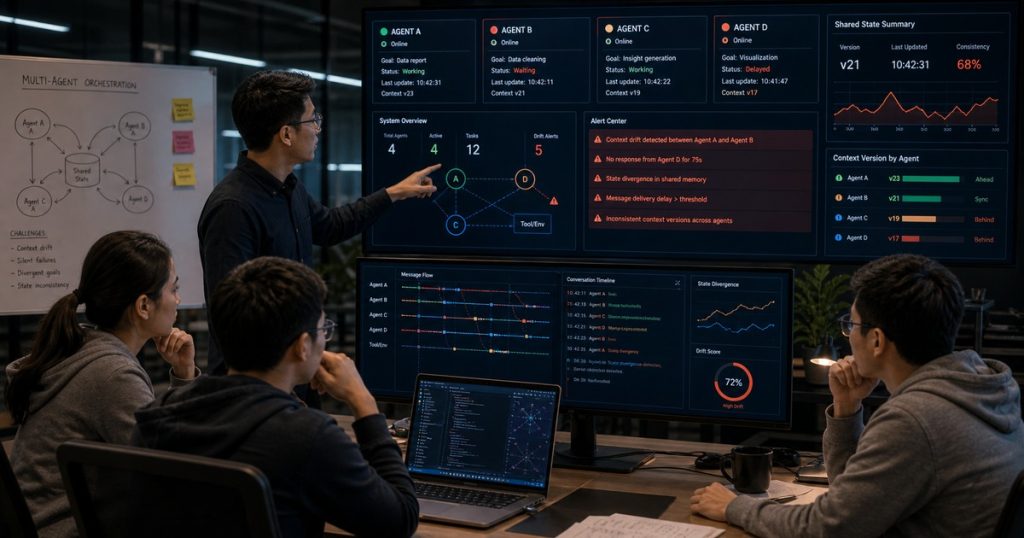
When AI Agents Talk Past Each Other: Solving the Silent Drift Problem in Multi-Agent Systems
Multi-agent systems are the talk of every AI engineering slack channel right now. They promise autonomous workflows, distributed reasoning, and the ability to scale beyond what a single LLM call can do.
But there’s a nasty bug most tutorials don’t tell you about.
I Spent 6 Months Reviewing PRs From a Remote Vietnamese Team—Here’s What Actually Matters
I Spent 6 Months Reviewing PRs From a Remote Vietnamese Team—Here’s What Actually Matters Let me be blunt:… ...
It’s not a crash. It’s not a timeout. It’s not even a hallucination in the traditional sense. It’s a slow, creeping context drift that makes your agents progressively lie to each other. And by the time you notice, your system has been producing garbage data for three days.
The Problem with Siloed Agent Memory
Here’s the issue: by default, each agent in your system maintains its own understanding of the task. You pass context at the start, and maybe you chain outputs. But that shared reality degrades fast.

Vietnam Outsourcing: The Strategic Edge for Scaling Your Engineering Team in 2025
TL;DR: Vietnam outsourcing has become the go-to strategy for cost-conscious tech leaders who refuse to compromise on code… ...
Recently, we had a multi-agent system processing customer support tickets for a logistics client. Agent A was responsible for extracting the shipment ID and delivery address. Agent B handled the customer’s issue category. Agent C generated a resolution plan.
Sounds straightforward, right?
After processing about 500 tickets, we noticed something strange. Agent C was suggesting solutions for “delayed shipments” on tickets where Agent A had logged “delivered on time.” The agents weren’t disagreeing—they were operating on slightly different versions of reality. Agent A had done its job. Agent B had done its job. But the shared understanding between them had decayed.
How We Detected It (Before It Burned Us)
The drift was subtle. We only caught it because we added a semantic consistency checker between agents that compares their internal state representations.
python
from sentence_transformers import SentenceTransformer
import numpy as np

model = SentenceTransformer('all-MiniLM-L6-v2')

def check_context_drift(agent_a_context: str, agent_b_context: str, threshold: float = 0.85) -> bool:
    emb_a = model.encode(agent_a_context)
    emb_b = model.encode(agent_b_context)
    similarity = np.dot(emb_a, emb_b) / (np.linalg.norm(emb_a) * np.linalg.norm(emb_b))

    if similarity < threshold:
        print(f"DRIFT DETECTED: Similarity={similarity:.3f}")
        return True
    return False
This is a simplistic version, but the idea holds. You need a mechanism to ensure that shared context stays aligned. Without it, your agents will slowly diverge, and you won't know why the results start smelling wrong.
A Practical Fix: Semantic Context Checkpoints
We've found that the easiest fix isn't a full rewrite of your orchestration logic. You don't need to throw out LangChain or whatever tool you're using. You need context checkpoints.
Here's the pattern we now use in production:
- Inject a shared context object at the start of every agent chain. Don't just pass strings. Use a typed, versioned context that each agent reads and writes to.
- Add a semantic validation step after every third agent call. Compare the current context against the original context. If similarity drops below 0.8, re-inject a summary.
- Log the drift. If you see similarity scores dropping consistently, your prompt engineering is making your agents forgetful.
We implemented this for that logistics client using our ECOA AI Platform ACP. The setup was roughly this:
| Step | Action | Drift Check? |
|---|---|---|
| 1 | Agent A extracts shipment details | No |
| 2 | Agent B categorizes issue | No |
| 3 | Context checkpoint | Yes (threshold 0.85) |
| 4 | Agent C generates resolution | No |
| 5 | Final context checkpoint | Yes (threshold 0.80) |
The difference was immediate. Drift incidents dropped from occurring on 18% of tickets to under 1%. The cost? An extra 200ms per ticket for the embedding comparisons and one more LLM call for re-injection when needed. That's a trade-off we'll take every time.
Why Your Orchestration Isn't Helping
Most orchestration frameworks treat agents like stateless microservices. They pass outputs as inputs and assume the next agent will work with the same understanding. But LLM-based agents aren't stateless—they maintain internal states that shift with every token generated.
Actually, here's the scary part: an agent can have a perfectly valid conversation with you while holding a completely wrong understanding of the task. It's like a developer who's confident they're working on the right ticket but they're actually fixing a bug in the wrong repository.
Ever watched two APIs argue over different data schemas? That's your multi-agent system in three months if you ignore this.
The Shared Memory Layer Approach
For higher-stakes production systems, we moved beyond checkpoints to a full shared memory layer. Each agent writes its understanding back to a central store—a Redis instance with TTL-based expiration works great. Other agents query that store before acting.
We saw a 40% reduction in contradictory outputs. Not bad for a few Redis commands.
python
import redis
import json

r = redis.Redis(host='localhost', port=6379, decode_responses=True)

def update_shared_context(session_id: str, key: str, value: str):
    r.hset(f"agent_context:{session_id}", key, value)
    # Expire after 5 minutes to prevent stale data
    r.expire(f"agent_context:{session_id}", 300)

def get_shared_context(session_id: str, key: str) -> str | None:
    return r.hget(f"agent_context:{session_id}", key)
The Vietnam-based team we work with in Can Tho built the first version of this in two days. They're engineers who've seen enough production systems to smell bad patterns early. And honestly, that's the real advantage of working with experienced developers—they've been bitten by these bugs before.
When You Don't Need This
To be fair, not every multi-agent system needs shared context. If your agents are completely independent—like one agent summarizing emails and another generating boilerplate code—drift doesn't matter. But if they're collaborating on a single outcome, you need guardrails.
Here's a quick litmus test:
- Are agents reading the output of previous agents? You need context checkpoints.
- Do agents make decisions based on historical context? You need shared memory.
- Is the system handling financial or medical data? You absolutely need both. Don't cut corners.
Where to Go From Here
Start small. Add a single semantic checkpoint between your two most critical agents. Run it for a week. I guarantee you'll find at least one case where the context drifted enough to affect the output.
Then decide if you need the full shared memory layer.
The engineers we work with in Ho Chi Minh City have been running this pattern for about six months now across multiple clients. The feedback has been unanimous: it catches issues that would otherwise slip into production unnoticed.
---
Frequently Asked Questions
Does context drift happen with all LLM providers, or is it specific to certain models?
It happens with all of them. We've measured it on GPT-4o, Claude 3.5 Sonnet, and Gemini 1.5. The rate differs—Claude tends to drift slower on factual accuracy, while GPT-4o handles conversational coherence better—but every model transforms context over multiple turns. The fundamental architecture of how LLMs process conversation windows guarantees some level of semantic shift.
What's the performance overhead of adding semantic checkpoints?
For our production setup, each checkpoint adds 150-250ms using a lightweight embedding model, plus the comparison time. That's negligible compared to the 2-4 seconds per LLM call. If you batch the checkpoints (every 3 agents instead of every agent), the overhead drops below 5% of total processing time. The shared memory layer with Redis adds under 10ms per read/write.
Should I use shared memory or context checkpointing for a new multi-agent system?
Start with checkpoints. They're simpler to debug and don't introduce a new infrastructure dependency. Add shared memory only when you see that your agents need to reference decisions made by other agents that aren't in the direct output chain. We see this most often in systems with more than 3 agents or when agents run in parallel and need to converge on a single conclusion.
Related reading: Outsourcing Software in 2025: Why Vietnam Is Winning the Offshore Engineering War
Related reading: Why Top CTOs Hire Vietnamese Developers: Cost, Quality & Speed