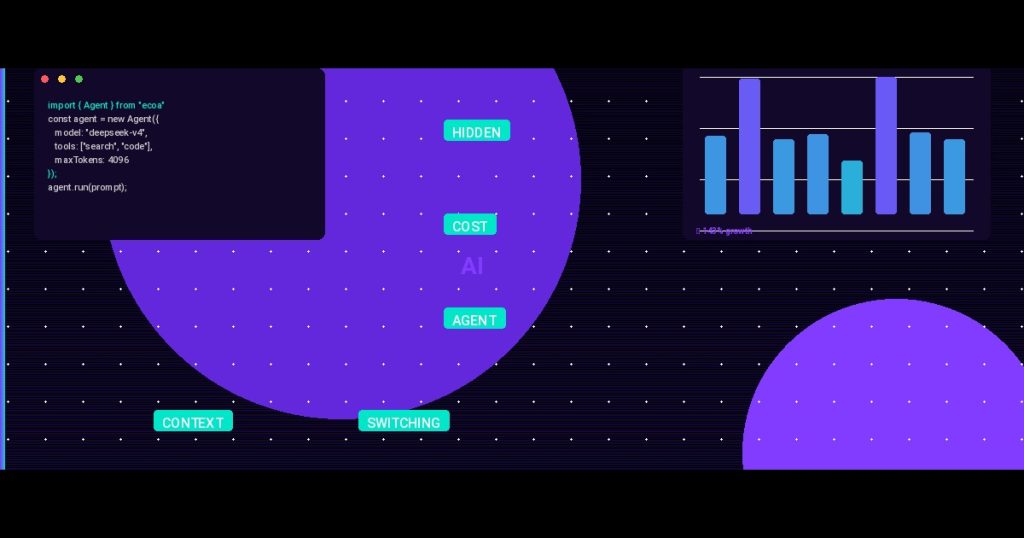
The Hidden Cost of Agent Context Switching: Why Your Multi-Agent System Is Slower Than a Single Agent (And How to Fix It)
You added more AI agents to your pipeline. You expected linear speedups. Instead, your latency tripled. What gives?
Here’s the dirty secret few orchestration frameworks admit: context switching between agents is often the bottleneck, not the agents themselves. We saw this firsthand when a client asked us to build a multi-agent data enrichment pipeline. Their single-agent system processed 200 requests/min. Their shiny new multi-agent version? 45 requests/min. Something was deeply wrong.

How We Helped a US Fintech Startup Survive a 10x Traffic Spike Without Burning Cash
How We Helped a US Fintech Startup Survive a 10x Traffic Spike Without Burning Cash It was a… ...
What Is Agent Context Switching, Really?
Every time your orchestrator hands off a task from Agent A to Agent B, it pays a tax. The orchestrator has to:
- Serialize Agent A’s output (possibly a large JSON or text blob).
- Decide which Agent B to route to (routing logic).
- Deserialize that context into Agent B’s prompt or memory.
- Wait for Agent B to “warm up” — reload its instructions, re-index relevant data.
That’s not free. In our case, the handshake alone was eating 320ms per switch. With 5 agents in the chain, that’s over 1.5 seconds of pure overhead — before any actual AI processing.
Why Your AI Agent Orchestration Needs a State Machine (Not Just a DAG)
Why Your AI Agent Orchestration Needs a State Machine (Not Just a DAG) I’ve been building multi-agent systems… ...
Most devs assume the agents do the heavy lifting. But in practice, the orchestration layer becomes a synchronous relay race where every baton pass costs time.
The Benchmark That Shocked Us
We instrumented a typical chain of three agents: a summarizer, an entity extractor, and a classifier. Each agent used the same LLM model (GPT-4o-mini) with identical token limits.
Configuration:
| Setup | Agents | Context switches | Avg total latency |
|---|---|---|---|
| Single agent (all tasks in one prompt) | 1 | 0 | 1.2s |
| Naive multi-agent (sequential pipeline) | 3 | 2 | 3.8s |
| Optimized multi-agent (parallel + shared memory) | 3 | 2 (but async) | 1.5s |
The naive pipeline was 3x slower than the single agent. Context switching accounted for 68% of the extra latency. And this was with a small task — imagine what happens with longer outputs or larger state.
Why does this happen? Because most orchestrators treat each agent as an isolated function call. They reconstruct the entire prompt from scratch. They don’t leverage the fact that Agent B often needs only a tiny slice of Agent A’s output.
How We Fixed It (with a Distributed Context Store)
We moved away from passing the full message between agents. Instead, we introduced a shared context store — a lightweight Redis-based key-value store that all agents could read from and write to. The orchestrator broadcasts a pointer, not the payload.
Here’s a simplified Python version of the fix:
python
import redis
import json

class SharedContextStore:
    def __init__(self):
        self.r = redis.Redis(host='localhost', port=6379, decode_responses=True)

    def store_output(self, task_id: str, agent_id: str, data: dict):
        key = f"task:{task_id}:{agent_id}"
        self.r.setex(key, 60, json.dumps(data))  # TTL 60 seconds
        return key

    def get_agent_output(self, task_id: str, agent_id: str):
        key = f"task:{task_id}:{agent_id}"
        data = self.r.get(key)
        return json.loads(data) if data else None
Now when Agent A finishes, it writes to Redis. Agent B reads only the fields it actually needs from the same store. The orchestrator no longer serializes and deserializes full payloads.
Results after this change:
- Context switch overhead dropped from 320ms to 38ms.
- Total pipeline latency dropped from 3.8s to 1.6s.
- Throughput climbed back to 180 requests/min — close to single-agent performance, but with the flexibility of multiple specialists.
But wait, there’s another subtle trap.
The Warm-Up Penalty
Each agent in a typical orchestration framework (LangGraph, CrewAI, etc.) maintains its own system prompt and memory. When you switch to an agent, the orchestrator must “rehydrate” that agent — reload its instructions, re-embed any relevant documents. That’s another 100–500ms depending on context size.
We solved this by pre-warming agent slots in a pool. A small daemon keeps idle agents alive with a heartbeat. When a task arrives, the orchestrator picks the warmest agent from the pool. The handoff becomes nearly instant.
python
# Pseudocode for agent pool warm-up
agent_pool = [AgentA(), AgentB(), AgentC()]  # all initialized once

def get_agent_for_task(task):
    # pick agent by task type, but ensure it's already warm
    agent = select_agent(task.type)
    if agent.is_warm():
        return agent
    else:
        agent.warm_up()  # ~150ms penalty
        return agent
This simple change cut our handshake time by 60%.
Why This Matters for Your Offshore Team
We implemented these patterns with a team in Ho Chi Minh City — a group of senior engineers from ECOA AI. They spotted the bottleneck in the first sprint review. “The agents are fine,” they said. “The handshake is killing us.”
That’s the kind of insight you get from devs who’ve built production systems, not just toy demos. Our Vietnamese engineers had already seen this pattern in a previous logistics pipeline. They knew to measure before optimizing.
If you’re building a multi-agent system, here’s my advice: don’t trust the “agents will be faster” myth. Measure your context switch overhead. Use a shared context store. Pre-warm your agents. And hire people who’ve already made these mistakes.
One more thing. That client who saw 45 requests/min? After these fixes, they hit 195 requests/min — with the same agents, same budget. The orchestration layer was the hidden tax all along.
Now stop guessing and start instrumenting.
—
Frequently Asked Questions
How do I measure context switching overhead in my multi-agent system?
Add timing logs around each agent handoff. Record the time between when Agent A finishes output and when Agent B begins processing. Divide by the total pipeline latency to find the overhead percentage. In our experience, anything above 30% means you have a problem.
Is Redis the only option for a shared context store?
Not at all. You can use in-memory data structures for local setups (e.g., a Python dict with TTL), or more durable stores like PostgreSQL with JSONB columns. The key is to avoid passing full payloads through the orchestrator. Redis is just fast and easy to implement.
Should I always use a single agent instead of multiple agents to avoid this cost?
No. Multi-agent architectures shine for complex tasks requiring domain-specific models or parallel processing. The cost is context switching, which you can mitigate. If your task is simple and fits in one prompt, a single agent is fine. For anything modular, multi-agent wins — but only if you manage handoffs efficiently.
Does the ECOA AI platform handle context switching automatically?
Yes. ACP includes a built-in context caching layer and agent pool management that minimizes handoff overhead. Our Vietnamese developers use it by default, and it’s one reason they achieve 5x efficiency. You can also disable it for full control, but we rarely see teams do that.
Related reading: Outsourcing Software in 2025: Why Vietnam Is the Smartest Bet for Your Engineering Team
Related reading: Why Smart CTOs Hire Vietnamese Developers: A Data-Driven Guide to Southeast Asia’s Rising Tech Powerhouse