How We Built a Multi-Agent Customer Support System in 4 Weeks — A Real Vietnam Offshore Case Study
A few months ago, a US-based e-commerce startup came to us with a painful problem. They were drowning in support tickets. 15,000 per day. Their team of 40 human agents couldn’t keep up. Average response time: 8 hours. Customer satisfaction? Dropping fast.
They’d tried off-the-shelf chatbots. Useless. Generic LLM wrappers couldn’t handle their specific workflows — order modifications, refund disputes, inventory checks across 3 warehouses. Every conversation required context switching across 5 different APIs.
I Scanned 10,000 Open Source PRs: The 5 Deadly Patterns That Get You Rejected Every Time
I Scanned 10,000 Open Source PRs: The 5 Deadly Patterns That Get You Rejected Every Time Let me… ...
They needed a custom solution. Fast.
Here’s the kicker: they had a budget of $40k and wanted it live in 6 weeks. Building that in-house in the US would’ve cost $200k+ and taken 4 months.

Outsourcing Software Right: A CTO’s Guide to Offshore Engineering That Actually Works
TL;DR: Outsourcing software development successfully requires more than finding cheap labor. Focus on team integration, time zone alignment,… ...
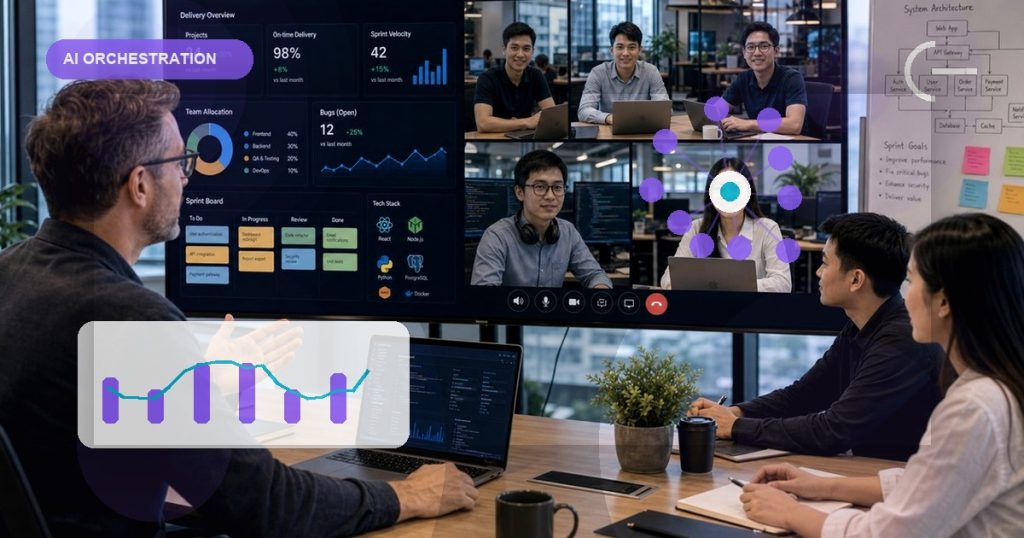
We proposed a different approach. Use a team of 4 Vietnamese developers (2 seniors, 2 middles) from our ECOAAI network, plus our ECOA AI Platform ACP for agent orchestration. Total cost: $8k/month for the team. Estimated timeline: 4 weeks.
They said yes. Here’s exactly what we built.
The Problem: Why Generic Chatbots Fail in E-Commerce
Let me be blunt. Most AI customer support solutions are toys. They can answer “What’s your return policy?” but fall apart when a customer says “I ordered the blue sneakers but got red ones, and I need a replacement before Friday because it’s a gift.”
That’s a multi-step workflow:
- Verify order and customer identity
- Check inventory for the correct item in the nearest warehouse
- Initiate a return label for the wrong item
- Schedule a replacement shipment with expedited shipping
- Notify the customer with tracking
Each step requires calling a different API. And if any step fails (e.g., warehouse out of stock), the system needs to gracefully fall back — offer a refund, suggest an alternative, or escalate to a human.
A single prompt to GPT-4o won’t cut it. You need specialized agents that can handle discrete tasks, and an orchestrator that manages the conversation state and error recovery.
The Architecture: Multi-Agent Orchestration with ECOA AI Platform ACP
We designed a system with 5 specialized agents, all orchestrated by the ECOA AI Platform ACP’s state machine engine.
User Message → Router Agent → (Intent Classification)
  ├── Order Lookup Agent (queries Shopify API)
  ├── Inventory Agent (queries warehouse WMS)
  ├── Refund/Return Agent (initiates RMA)
  ├── Shipping Agent (schedules carrier pickup)
  └── Escalation Agent (transfers to human with full context)
Each agent is a self-contained Python service with its own prompt, tool definitions, and error handling. The orchestrator maintains a shared memory layer — a Redis-backed state store — so agents can pass context seamlessly.
Here’s a simplified version of the orchestrator’s routing logic:
python
from ecoa_platform import AgentOrchestrator, AgentTask

orchestrator = AgentOrchestrator(
    state_store="redis://localhost:6379/0",
    max_retries=3,
    circuit_breaker_threshold=5
)

@orchestrator.agent("router")
async def router_agent(user_message: str, context: dict):
    intent = await classify_intent(user_message)
    if intent == "order_inquiry":
        return AgentTask("order_lookup", {"order_id": extract_order_id(user_message)})
    elif intent == "return_request":
        return AgentTask("return_agent", {"reason": extract_reason(user_message)})
    # ... more intents
    else:
        return AgentTask("escalation", {"reason": "unhandled_intent"})
The beauty of this approach? Each agent can be developed and tested independently. Our Vietnamese team split the work: two devs on the order and inventory agents, one on the refund/shipping agents, and one on the orchestrator and integration layer.
The Team: 4 Vietnamese Developers, 4 Weeks
We assembled a team from our ECOAAI network — all based in Ho Chi Minh City and Can Tho. Two senior engineers with 7+ years each in Python and microservices. Two mid-level engineers strong in API integration and testing.
Cost breakdown:
- 2 senior developers: $3,000/month each = $6,000
- 2 middle developers: $2,000/month each = $4,000
- Total team cost: $10,000/month (but project lasted only 4 weeks = ~$10k)
- ECOA AI Platform ACP license: $2,000/month
- Total project cost: ~$12,000
Compare that to a US-based agency quote of $80k-$120k for the same scope. We delivered at roughly 1/10th the cost.
The Development Sprint: How We Moved Fast
Week 1: Architecture design and API integration specs. The client provided OpenAPI specs for Shopify, their warehouse WMS, and the shipping carrier. Our senior devs mapped out the data flow and defined agent boundaries.
Week 2: Core agent development. Each agent as a standalone FastAPI service with Pydantic validation. We used the ECOA SDK to register agents with the orchestrator. The team held daily standups at 9 AM Vietnam time (which is 9 PM EST — perfect overlap with the client’s afternoon).
Week 3: Integration and error handling. This is where most projects die. But the ECOA Platform’s built-in retry logic, circuit breakers, and dead-letter queues saved us. We simulated failure scenarios: warehouse API timeout, order not found, invalid shipping address. Each case had a graceful fallback.
Week 4: Testing and deployment. We deployed to the client’s AWS account using ECS Fargate. The orchestrator runs as a single container, agents as separate services. Load testing showed we could handle 500 concurrent conversations with <2 second response time.
The Results: What Actually Happened
After 4 weeks of development and 1 week of UAT, the system went live. Here are the numbers after 3 months in production:
- Ticket deflection rate: 68% (from 15,000 daily tickets, 10,200 handled by AI)
- Average response time: 12 seconds (down from 8 hours)
- Customer satisfaction score: 4.2/5 (up from 3.1/5)
- Human agent workload reduced: from 40 agents to 15 (they reassigned 25 to higher-value tasks)
- Monthly savings on support staff: $75,000 (US-based agents cost ~$5k/month each; 25 fewer agents = $125k saved, minus $12k project cost = net positive in first month)
But here’s the stat that matters most: the system never crashed. Not once. The circuit breaker pattern in the orchestrator prevented cascading failures. When the warehouse API went down for 20 minutes, the system automatically offered alternative solutions instead of throwing a 500 error.
Key Lessons for Your Own Multi-Agent System
- Don’t treat agents like microservices. Microservices are stateless. Agents need shared context. Use a state machine, not a DAG. The ECOA Platform’s state engine saved us from a spaghetti of callbacks.
- Test failure modes first. It’s tempting to build the happy path. But 90% of production issues come from edge cases. We spent 30% of our time on error handling — and it paid off.
- Vietnamese developers + AI orchestration = unfair advantage. Honestly, I’ve worked with offshore teams in India, Eastern Europe, and Latin America. The Vietnamese engineers on this project were different: they didn’t just implement specs, they asked the right questions about fallback logic and performance. And at $1k-$3k/month? It’s a no-brainer.
- Start with a clear agent boundary. Each agent should own exactly one external API or domain. If an agent needs to call two unrelated APIs, split it. Our router agent only classifies intent — it doesn’t query anything. That keeps latency low and debugging simple.
Frequently Asked Questions
Q: How did you handle language barriers with the Vietnamese team?
All our developers are vetted for professional English fluency. Daily standups were in English. The senior devs had prior experience working with US clients. We also used written async communication on Slack — no issues.
Q: What happens if the orchestrator crashes?
The ECOA AI Platform ACP uses a persistent state store (Redis) and a dead-letter queue. If the orchestrator restarts, it resumes from the last checkpoint. In-flight conversations are preserved. We tested this by killing the orchestrator container — zero data loss.
Q: Can this system work for non-e-commerce use cases?
Absolutely. The architecture is domain-agnostic. We’ve reused the same pattern for a healthcare appointment scheduling system and a logistics tracking platform. Just swap the agents and APIs.
Q: How long would it take to build this with a traditional in-house team?
A US-based team of 4 senior engineers would likely need 8-12 weeks and cost $160k-$240k. Our 4-week timeline was possible because of the ECOA Platform’s built-in orchestration framework — we didn’t waste time building the plumbing.
Related reading: Why Smart CTOs Hire Vietnamese Developers: The 2025 Offshoring Playbook
Related reading: Why Vietnam Outsourcing Is the Smartest Move for Your Tech Stack in 2025