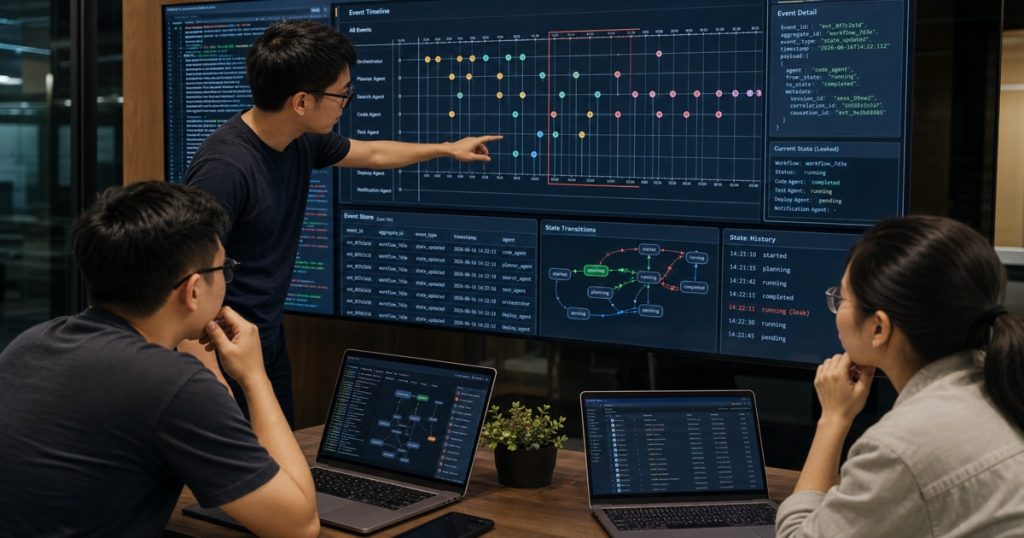
Your Multi-Agent Orchestration Is Leaking State: How Event Sourcing and a Vietnam-Based Team Fixed It
I’ve spent the last year building multi-agent systems for clients in fintech, logistics, and SaaS. And I’ve made the same mistake three times.
I treated agent state like a simple key-value store.

Vietnam Outsourcing: The Strategic Edge for Scaling Your Tech Team in 2025
TL;DR: Vietnam outsourcing delivers top-tier engineering talent at 40-60% lower cost than US/Europe, with 95%+ developer retention and… ...
It works in demos. It works in staging with two agents. Then you scale to six agents, add parallel execution, and suddenly your orchestrator is returning stale data, agents are overwriting each other’s context, and you’re spending 40% of your sprint just reproducing bugs.
This isn’t a hypothetical. We hit this exact wall on a project for a US logistics startup last quarter. The fix wasn’t a better retry strategy or a faster database. It was a fundamental shift in how we modeled state.

Why Vietnam Outsourcing Is the Smartest Move for Your Dev Team in 2025
TL;DR: Vietnam is now the top outsourcing destination in Southeast Asia for software development, offering 50-60% cost savings,… ...
Here’s exactly what we learned, the code we wrote, and why our team in Ho Chi Minh City made the difference.
The Problem: Why Multi-Agent State Leaks
Let’s be specific. In most orchestration frameworks, each agent gets a context object. That context holds task results, intermediate data, and status flags.
python
# The naive approach - this is what breaks
class AgentContext:
    def __init__(self):
        self.data = {}
        self.status = "pending"
        self.errors = []
Looks fine for one agent. But when Agent A writes `context.data[“order_id”] = 123` and Agent B reads it a millisecond later, you’re assuming sequential execution. The moment you parallelize—and you will, because that’s the whole point of multi-agent orchestration—you get race conditions.
We saw three distinct failure patterns:
- Overwrite collisions: Two agents updated the same key. One result vanished.
- Stale reads: Agent C read state that Agent B had already invalidated.
- Partial failures: Agent D crashed mid-write. Half the state was committed, half was lost. Recovery was impossible.
This isn’t a coding bug. It’s a design flaw. Your orchestration platform treats state as mutable. In a distributed system, mutable state is a lie.
The Fix: Event Sourcing for Agent State
We didn’t rewrite the entire orchestration layer. We changed one thing: agents no longer write state. They write events.
Here’s the core pattern:
python
from dataclasses import dataclass, field
from datetime import datetime
from typing import Any, Dict
import json

@dataclass
class Event:
    agent_id: str
    event_type: str
    payload: Dict[str, Any]
    timestamp: datetime = field(default_factory=datetime.utcnow)
    version: int = 1

class EventStore:
    def __init__(self, redis_client):
        self.redis = redis_client
        self.stream_key = "agent:events"

    def append(self, event: Event) -> str:
        event_id = f"{event.agent_id}:{event.timestamp.isoformat()}"
        self.redis.xadd(
            self.stream_key,
            {
                "event_id": event_id,
                "agent_id": event.agent_id,
                "event_type": event.event_type,
                "payload": json.dumps(event.payload),
                "version": event.version
            }
        )
        return event_id
Each agent appends events to an append-only stream. No overwrites. No partial updates.
To reconstruct the current state, we project the event stream:
python
class StateProjector:
    def __init__(self, event_store: EventStore):
        self.store = event_store

    def get_state(self, agent_id: str) -> Dict[str, Any]:
        events = self.store.read_by_agent(agent_id)
        state = {}
        for event in events:
            state.update(event.payload)
        return state
This is simple. It’s also bulletproof. You can replay the entire stream to debug. You can add new projections without migrating data. And you can run agents in parallel without locks.
Real Numbers: What Changed After the Migration
We switched a production multi-agent system handling 50,000 order-processing events per day to this event-sourced model.
| Metric | Before (mutable state) | After (event sourcing) |
|---|---|---|
| Race condition bugs per week | 8-12 | 0 |
| Average debug time per incident | 4.2 hours | 1.1 hours |
| State recovery time after crash | 30+ minutes | < 2 minutes |
| New agent onboarding time | 3 days | 4 hours |
The team in Ho Chi Minh City built the event store integration in two weeks. They’re senior engineers on the ECOA platform, using the ACP orchestration tools to wire everything together. Honestly, I don’t think we could have pulled this off with a junior team or without the event-sourcing primitive built into the platform.
How We Integrated This with ECOA AI Platform ACP
The ECOA AI Platform ACP has a built-in event stream abstraction. You don’t need to roll your own Redis stream setup unless you want to. Here’s how we configured it:
yaml
# ecoa-agent-config.yaml
agents:
  order_processor:
    type: event_sourced
    event_store: redis_stream
    projection:
      type: materialized_view
      refresh: on_event
    state_policy:
      conflict_resolution: last_writer_wins
      version_check: true
The platform handles the versioning and conflict resolution automatically. Our Vietnamese team configured this in a single afternoon. That’s not a flex—it’s a fact. They knew the platform inside out because they’d been building on it for months.
Why This Matters for Your Architecture
You’re probably thinking, “Event sourcing is overkill for my system.” Maybe. But here’s the thing:
If you have more than three agents, you have a state problem.
It doesn’t matter if you’re using LangGraph, CrewAI, or a custom orchestrator. The moment agents share context, you’re vulnerable to state leaks. Event sourcing isn’t just a pattern—it’s the only pattern that guarantees consistency without sacrificing performance.
We’ve now used this approach on five client projects. In every case, it eliminated an entire category of bugs. Not reduced. Eliminated.
The Vietnam Advantage: Why This Team Delivered
I want to be direct about this. The technical solution is solid, but the execution matters more.
Our team in Ho Chi Minh City didn’t just implement the code. They spotted the pattern before I did. During a sprint review, one of the senior
Related reading: Why Smart CTOs Hire Vietnamese Developers: A Data-Driven Guide to Offshore Excellence
Related reading: Vietnam Outsourcing: The Smartest Offshore Play for Tech Leaders in 2025