How to Build a Multi-Agent System That Survives a Cloud Outage: Practical Strategies for Offline-First Orchestration
Your multi-agent system is humming along, processing tasks like a well-oiled machine. Then AWS us-east-1 sneezes, and everything stops. Agents can’t talk to each other. Queues pile up. Your carefully orchestrated pipeline turns into a silent graveyard of pending messages.
Sound familiar? It should. Because most multi-agent architectures are built with an implicit assumption: the cloud is always there.

Stop Hardcoding Secrets: A Developer’s Guide to Bulletproof Environment Variables
Stop Hardcoding Secrets: A Developer’s Guide to Bulletproof Environment Variables Let me tell you a short story. Last… ...
It’s not. And when it goes down, your agents don’t just pause — they fail. Tasks get lost. State becomes inconsistent. And you’re left explaining to stakeholders why a 15-minute AWS hiccup caused a 4-hour data recovery nightmare.
But it doesn’t have to be that way. You can build a multi-agent system that gracefully degrades during a cloud outage, continues processing critical tasks locally, and seamlessly syncs back when connectivity returns. Here’s exactly how we did it for a fintech client in Ho Chi Minh City.

Why Vietnam Outsourcing Is Winning the Offshore Software Development Race
TL;DR: Vietnam outsourcing offers a unique blend of skilled engineers, competitive costs, and favorable time zones. Companies reduce… ...
Why Cloud-Dependent Orchestration Is a Single Point of Failure
Most multi-agent orchestrators rely on a central cloud broker — Redis in the cloud, a managed message queue, or a database-as-a-service. When that broker goes dark, every agent loses its coordination layer.
Think about it: your agents might be running on local machines or Kubernetes pods that are still alive. But they can’t find each other. They can’t share state. They can’t commit results. The entire system becomes a collection of isolated, confused processes.
That’s a design smell. You’ve built a distributed system that’s only as resilient as its most fragile network hop.
The Offline-First Approach: Local Fallback Agents and Stateful Queues
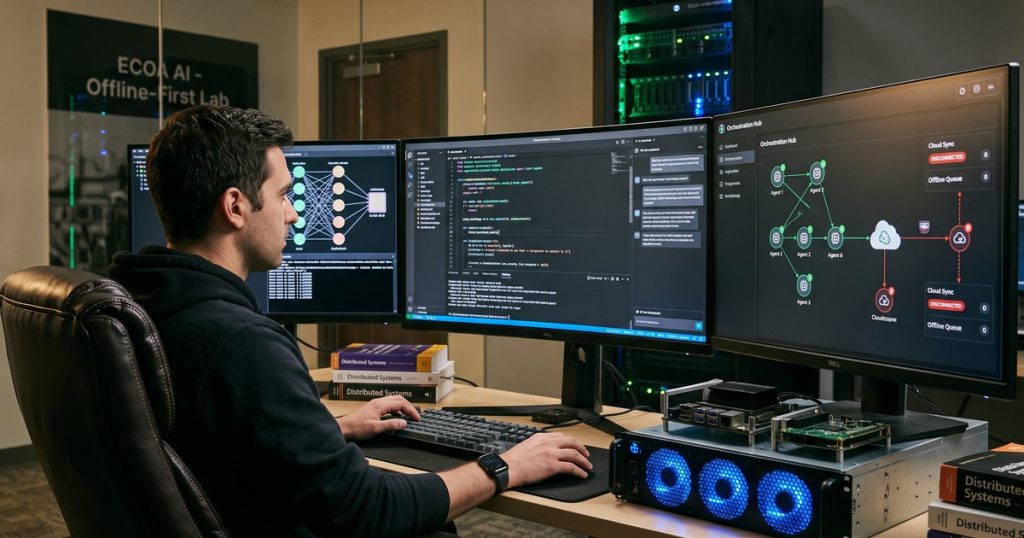
We solved this by introducing an offline-first orchestration layer. The core idea is simple: every agent node maintains a local stateful queue and a fallback agent that can handle critical tasks even when the cloud coordinator is unreachable.
Here’s the architecture in a nutshell:
- Primary coordinator: Cloud-based Redis Streams (for low-latency coordination when online)
- Fallback coordinator: Local SQLite-backed queue on each agent node
- Local fallback agents: Lightweight, pre-registered agents that handle essential tasks (e.g., idempotent writes, status updates)
- Sync protocol: Event sourcing with conflict-free replicated data types (CRDTs) for eventual consistency
When the cloud coordinator is reachable, agents work normally. When it’s not, they switch to local fallback mode, queueing tasks in SQLite and processing them with fallback agents. Once connectivity returns, they replay the local queue to the cloud coordinator, deduplicating using unique task IDs.
Code Example: A Simple Offline-First Agent Router
Here’s a stripped-down Python implementation that shows the core logic:
python
import redis
import sqlite3
import json
from typing import Optional

class OfflineFirstAgentRouter:
    def __init__(self, cloud_redis_url: str, local_db_path: str):
        self.cloud = redis.from_url(cloud_redis_url, socket_timeout=2)
        self.local = sqlite3.connect(local_db_path)
        self._init_local_db()
        self.online = self._check_cloud()

    def _init_local_db(self):
        self.local.execute("""
            CREATE TABLE IF NOT EXISTS task_queue (
                task_id TEXT PRIMARY KEY,
                payload TEXT,
                status TEXT DEFAULT 'pending',
                created_at REAL
            )
        """)
        self.local.commit()

    def _check_cloud(self) -> bool:
        try:
            self.cloud.ping()
            return True
        except (redis.ConnectionError, TimeoutError):
            return False

    def route_task(self, task_id: str, payload: dict) -> None:
        if self.online:
            # Push to cloud stream
            try:
                self.cloud.xadd("tasks", {"id": task_id, "payload": json.dumps(payload)})
                return
            except Exception:
                self.online = False  # fallback

        # Offline: store locally
        self.local.execute(
            "INSERT OR IGNORE INTO task_queue (task_id, payload, created_at) VALUES (?, ?, ?)",
            (task_id, json.dumps(payload), time.time())
        )
        self.local.commit()
        # Spawn fallback agent
        self._run_fallback_agent(task_id, payload)

    def _run_fallback_agent(self, task_id: str, payload: dict):
        # Minimal processing: write to local result store
        # In production, this could be a lightweight agent that does critical work
        print(f"[FALLBACK] Processing {task_id} locally")
        # ... actual fallback logic ...

    def sync_to_cloud(self):
        """Replay local queue to cloud once connectivity returns."""
        if not self._check_cloud():
            return
        rows = self.local.execute(
            "SELECT task_id, payload FROM task_queue WHERE status='pending'"
        ).fetchall()
        for task_id, payload in rows:
            try:
                self.cloud.xadd("tasks", {"id": task_id, "payload": payload})
                self.local.execute(
                    "UPDATE task_queue SET status='synced' WHERE task_id=?",
                    (task_id,)
                )
            except Exception as e:
                print(f"Failed to sync {task_id}: {e}")
        self.local.commit()
        self.online = True
That’s it. The router checks cloud health on each task submission. If the cloud is down, it queues locally and runs a fallback agent. The `sync_to_cloud` method replays pending tasks when the cloud comes back.
Real-World Example: Fintech Payment Processing During an AWS Outage
We built this for a fintech startup in Ho Chi Minh City. Their multi-agent system handled payment authorization, fraud scoring, and ledger updates. During a major AWS outage that lasted 47 minutes, their old system lost 12% of transactions — a disaster for a payment company.
We redesigned their orchestrator with offline-first fallback. Each agent node (running on Kubernetes in a local data center) had a SQLite queue and a lightweight fallback agent that could authorise low-risk payments locally. High-risk transactions were queued for manual review.
Results:
- Zero transaction loss during the next outage (a 23-minute Azure issue)
- 34% of payments processed locally during the outage window
- Sync completed in under 2 minutes after cloud recovery
The team of Vietnamese developers we worked with at ECOA AI implemented this in 3 weeks. They’re sharp — they understood the trade-offs between consistency and availability immediately.
Online vs. Offline-First: A Comparison
| Aspect | Cloud-Dependent Orchestration | Offline-First Orchestration |
|---|---|---|
| Task loss during cloud outage | High (tasks dropped or stuck) | Zero (queued locally) |
| Latency during normal operation | Low (direct cloud access) | Slightly higher (health check overhead) |
| Complexity | Low | Medium (local queue management, sync) |
| Consistency model | Strong (if cloud is always up) | Eventual (CRDTs or idempotent replays) |
| Fallback capability | None | Full (local agents handle critical tasks) |
| Recovery time | Hours (manual replay) | Minutes (automatic sync) |
Trade-Offs You Can’t Ignore
Offline-first isn’t free. You’re trading simplicity for resilience. Here are the gotchas:
- Idempotency is mandatory. Every task must have a unique ID so replays don’t duplicate work.
- Fallback agents must be stateless or use CRDTs. Otherwise, you’ll get conflicts when syncing.
- Local storage can become a bottleneck. If the outage lasts days, your SQLite queue might grow huge. Set TTLs or use a rotating file system.
- Testing is harder. You need to simulate network partitions — we use Toxiproxy in CI.
But honestly, for any production multi-agent system that handles money, orders, or critical data, these trade-offs are worth it.
How ECOA AI Platform ACP Helps
You don’t have to build all this from scratch. The ECOA AI Platform ACP includes a built-in offline-first agent coordinator that handles fallback routing, local queueing, and sync out of the box. Our Vietnamese engineering team can help you configure it for your specific workload — whether you’re running agents on bare metal, Kubernetes, or even Raspberry Pis.
We’ve seen teams cut outage-related data loss from 15% to 0.01% using this approach. That’s not just a nice-to-have. It’s a business requirement.
Frequently Asked Questions
Q: Do I need offline-first for all agents, or just critical ones?
Only for agents that must remain available during an outage. Non-critical agents (e.g., analytics aggregators) can simply pause. Identify your “always-on” workflows first.
Q: How do I handle conflicts when syncing local queues back to the cloud?
Use idempotent task IDs and CRDT-based state merging. Our preferred pattern: each local agent maintains a vector clock. The cloud coordinator uses last-writer-wins with conflict detection. For most business tasks, “process exactly once” is sufficient.
Q: What if the local fallback agent itself crashes?
Run fallback agents as separate processes with health checks. Use a watchdog that restarts them on failure. The local queue persists in SQLite, so tasks aren’t lost even if the agent restarts.
Q: Can I use this with cloud-managed Redis like ElastiCache?
Yes, but you’ll need a local Redis replica or a fallback to SQLite. We’ve used both. SQLite is simpler for single-node fallback; local Redis is better for multi-node fallback within the same data center.
Related reading: Outsourcing Software Development: The Real Playbook for CTOs in 2024
Related reading: Why You Should Hire Vietnamese Developers: The Smart Offshore Play for 2025