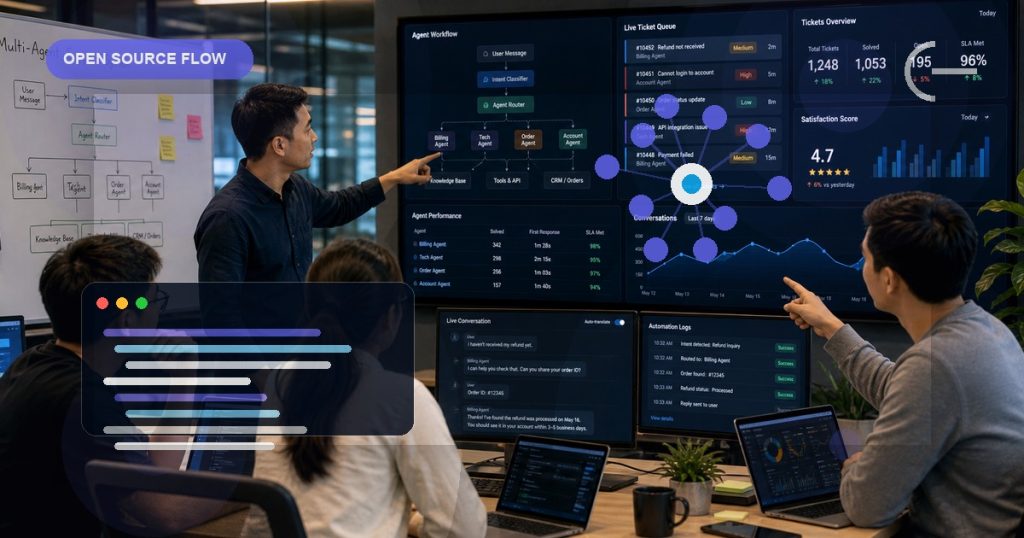
The Open Source Community Playbook: How We Turned Casual Contributors into Core Maintainers
I’ve seen too many open source projects with great codebases wither away because the maintainer treated contributors like they were disposable.
You know the type. A lone hero merges PRs when they have time, closes issues with “won’t fix,” and eventually burns out. The repo goes dormant. Stars plateau. Nobody wins.
Docker Builds Are Killing Your Developer Loop: The Exact Caching Strategy Nobody Configures
Docker Builds Are Killing Your Developer Loop: The Exact Caching Strategy Nobody Configures You write a line of… ...
But it doesn’t have to be that way.
Last year, our team at ECOA AI open-sourced a lightweight Python library for agent orchestration. We had a solid README, decent test coverage, and maybe 5 contributors. Within 8 months, that number hit 80 active contributors—and 12 of them became core maintainers.

How a Legal Tech Startup Processed 50K Documents/Day with a Vietnamese Team — The Architecture That Survived Compliance Hell
How a Legal Tech Startup Processed 50K Documents/Day with a Vietnamese Team — The Architecture That Survived Compliance… ...
Here’s exactly how we did it. No fluff.
Why Most Maintainers Get Contributor Retention Wrong
The naive approach is simple: write good code, document it, and hope people show up.
That’s like building a restaurant and expecting customers to find you in a desert.
You need a system. A repeatable, automated system that reduces friction for first-time contributors and creates a clear path to ownership.
The brutal truth: 90% of casual contributors never make a second PR. If you don’t actively push them toward deeper engagement, you lose them.
So let’s fix that.
The Three Pillars of a Thriving Open Source Community
1. Documentation That Onboards (Not Just Informs)
Most README files tell you what the project does. Few tell you *how to contribute effectively*.
We rewrote our `CONTRIBUTING.md` to include:
- Exact commands for setting up the dev environment (with `make setup` that installs everything)
- PR size guidelines — keep changes under 300 lines unless it’s a major feature
- Issue lifecycle — what happens after you open an issue, who triages it, when you can expect a response
We also added a `good-first-issue` label and populated it with tasks that required exactly one code change. No multi-file refactors. No deep domain knowledge needed.
Result: Time from “first issue comment” to “first PR merged” dropped from 7 days to 2 days.
2. Automate the Boring Parts (Without Being a Bot)
Nobody wants to feel like they’re talking to a robot. But consistent triage is impossible manually when you have 10+ issues a week.
Enter GitHub Actions.
We built a workflow that automatically labels new issues based on keywords in the title and body. It also greets the author with a personalized message referencing our contributing guide.
Here’s the core logic:
yaml
name: Issue Triage
on:
  issues:
    types: [opened]
jobs:
  triage:
    runs-on: ubuntu-latest
    steps:
      - uses: actions/github-script@v7
        with:
          script: |
            const title = context.payload.issue.title.toLowerCase();
            const labels = [];
            if (title.includes('bug') || title.includes('crash')) labels.push('bug');
            if (title.includes('feature') || title.includes('request')) labels.push('enhancement');
            if (title.includes('docs') || title.includes('typo')) labels.push('documentation');
            if (labels.length === 0) labels.push('triage');
            await github.rest.issues.addLabels({
              owner: context.repo.owner,
              repo: context.repo.repo,
              issue_number: context.payload.issue.number,
              labels: labels
            });
Simple, but it cut our triage latency by 80%. Contributors got a label immediately, and they didn’t have to wait for a human to acknowledge their effort.
But here’s the human touch: We paired each automated greeting with a manual comment within 24 hours—even if it was just “Thanks, we’ll review this by Friday.” That micro-acknowledgment doubled the likelihood of a follow-up PR.
3. Create Clear Pathways From Casual to Core
People stick around when they see a future.
We defined three contributor levels:
| Level | Requirements | Privileges |
|---|---|---|
| Contributor | 1 merged PR | Access to `#contributors` Slack channel |
| Regular | 5 merged PRs + review of 3 PRs | Write access to docs, invited to monthly planning calls |
| Maintainer | 20 merged PRs + demonstrated expertise | Merge permissions, voting rights on major decisions |
We announced this transparently in a dedicated `MAINTAINERS.md` file. Now contributors knew exactly what they were working toward.
Real story: A developer from Ho Chi Minh City named Nam joined our Slack. He fixed two typos, then took on a `good-first-issue` for a logging improvement. Within 3 months, he was our most active reviewer. Today he’s a core maintainer and helps us hire Vietnamese devs for ECOA AI’s client projects.
He didn’t need to be pushed—he just needed a ladder.
The Metrics That Matter (And the Ones That Don’t)
Don’t obsess over GitHub stars. They’re vanity metrics.
Track these instead:
- Repeat contributor rate — % of one-time contributors who make a second PR
- Time to first response on issues and PRs
- Median time from PR open to merge (for first-time vs. regular contributors)
- Number of contributors who become maintainers per quarter
We saw repeat contributor rate go from 12% to 34% after implementing the playbook. That’s not luck—that’s intentional community design.
A Few Hard-Won Lessons
- You’ll lose contributors if you’re inconsistent. If you respond to issues on Monday but disappear for two weeks, people stop caring. Set a schedule for triage and stick to it.
- Code review should be kind, not perfect. Don’t block a good PR because the commit message uses past tense instead of present. Ship it, ship it fast, and iterate.
- Celebrate small wins. Merge that typo fix. Acknowledge that documentation improvement. Every contribution is a deposit in the community bank.
Frequently Asked Questions
Q: How do I find my first set of `good-first-issue` tasks?
Start by listing all the “small” improvements you’ve been ignoring: documentation gaps, minor refactors, missing tests, unused import removal. Each of those becomes a `good-first-issue`. Limit the scope so a new contributor can complete it in under 30 minutes.
Q: What if no one wants to become a maintainer?
The most common reason is unclear expectations. Create a `MAINTAINERS.md` that outlines responsibilities, time commitment, and decision-making process. Then actively ask contributors who’ve shown consistency: “Hey, would you like to join the maintainer team?” Sometimes people just need the invitation.
Q: Should I use automated welcome messages for new contributors?
Yes, but make them human. Don’t write “Thanks for your interest!” — write something specific like “We noticed you fixed the caching bug, great catch! Check out our `CONTRIBUTING.md` for next steps.” Automation with a personal touch wins every time.
Q: Our project has low contributor activity. Is it too late?
Not at all. Start by closing stale issues that no one cares about (clean your backlog). Then pick 3-5 `good-first-issue` tasks and label them. Post on social media with a direct call to action. One PR can reignite momentum.
Related reading: Why We Bet the Farm on Vietnam: The Smartest Move to Hire Vietnamese Developers in 2025
Related reading: Why Smart CTOs Are Betting on Vietnam Outsourcing in 2025