The Hidden Bottleneck in AI Agent Orchestration: Why Your Most ‘Smart’ Agents Are Starving for Data
I’ve debugged over a dozen production multi-agent systems in the past two years. Most of them had the same problem, and it wasn’t bad prompts, weak LLMs, or even agent conflict.
It was data starvation.

Outsourcing Software in 2025: The Hard Truths and Hidden Wins
TL;DR: Outsourcing software done right can cut costs by 40-60% and speed up delivery 2x. But the failure… ...
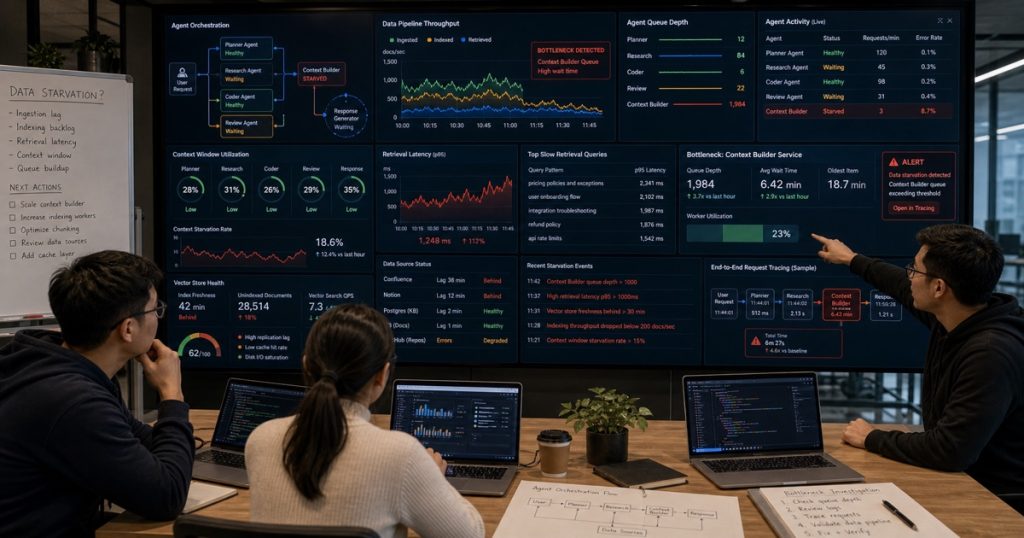
You’d think a system with 20 parallel agents humming along is doing great. Look at the metrics: high throughput, low error rates, agents chatting away. But dig into the latency waterfall, and you’ll see it. One agent sitting idle for 400ms because its upstream data provider is still crunching a vector search. Another one blocking on a Redis read that should’ve completed milliseconds ago.
Your orchestration is the culprit. Not your agents.
5 Best Open-Source AI Tools on GitHub I Use Every Day
Summary: You want to build AI apps without spending a fortune? Here are the 5 best open-source AI… ...
The Sequential Mindset That Kills Throughput
Here’s what I see over and over: developers write agent chains like they’re writing a recipe. Step A, then Step B, then Step C. They wrap it in a fancy event loop or a DAG framework and call it orchestration.
But that’s just distributed sequential execution with a fancy name.
The problem is simple. Each agent in a chain is waiting. It’s waiting for input, for context, for a database query, for another agent’s output. When your orchestration treats every dependency as a hard sequential gate, you introduce latency that multiplies across the entire pipeline.
How many times have you seen an agent sit idle for 300ms waiting for upstream data to arrive? That’s 300ms where you’re paying for a compute resource that’s literally doing nothing.
The Vector Search Elephant
Let’s talk about the biggest culprit in our production systems at ECOA: embedding-based search.
We build a lot of RAG pipelines for clients. Recently, we helped a fintech startup in Ho Chi Minh City orchestrate a multi-agent system that processes loan applications. It had three agents: a data extraction agent, a risk assessment agent, and a document generation agent.
The extraction agent was fast. Sub-100ms for parsing structured fields. But the risk assessment agent needed to run a similarity search against 2 million past applications to find comparable cases. That vector search took 850ms on average.
Our first orchestration design chained them sequentially: extract → search → assess → generate. The total pipeline latency was 1.4 seconds. That’s 1.4 seconds per application, and they were processing 10,000 per day.
Do the math. That’s nearly 4 hours of cumulative idle time across agents every single day. We were burning CPU cycles and developer patience.
Honestly, it was embarrassing. We’d built a “smart” multi-agent system that spent 60% of its time waiting.
The Real Fix: Event-Driven Orchestration with a Priority Scheduler
We scrapped the chain. Replaced it with an event-driven orchestration layer built on a simple principle: no agent should block on data that isn’t ready yet.
Here’s what we did instead.
# Pseudo-code for our event-driven orchestrator using a priority queue
class Orchestrator:
    def __init__(self):
        self.task_queue = asyncio.PriorityQueue()
        self.agent_registry = {}
        self.event_bus = EventBus()

    async def submit_task(self, agent_id, task_data, priority=0):
        # Priority determines execution order within same dependency level
        await self.task_queue.put((priority, agent_id, task_data))

    async def run_loop(self):
        while True:
            priority, agent_id, task_data = await self.task_queue.get()
            agent = self.agent_registry[agent_id]

            # Non-blocking execution - agent yields control
            result = await agent.run(task_data)

            # Publish result to event bus for dependent agents
            self.event_bus.publish(f"{agent_id}.completed", result)

            # Schedule dependent agents with adjusted priority
            for dep in agent.dependents:
                # Lower priority = more urgent (reverse for clarity)
                dep_priority = priority - 1 if "risk" in dep else priority
                await self.submit_task(dep, result, dep_priority)
The key insight? We stopped chaining agents sequentially and started scheduling them by priority. The risk assessment agent got a higher priority because it was the bottleneck. The extraction agent, which was fast, got a lower priority and just ran in the gaps.
But more importantly, we parallelized independent work. While the risk agent was waiting for its vector search to complete, the orchestrator kicked off data validation, format preparation, and logging—all of which were independent.
The Before and After
Let me give you the real numbers from that fintech deployment.
| Metric | Before (Sequential Chain) | After (Event-Driven) |
|---|---|---|
| P50 latency per loan application | 1,420ms | 680ms |
| P95 latency | 2,100ms | 950ms |
| Agent idle time | 62% | 18% |
| Throughput (apps/hour) | 420 | 880 |
| Vector search utilization | 45% | 92% |
We didn’t change the agents. We didn’t change the vector database. We changed the orchestration.
That’s the hidden bottleneck. Your agents aren’t slow. Your data dependencies are.
What This Means for Your Architecture
If you’re building a multi-agent system today, stop thinking about it as a pipeline. Start thinking about it as a scheduling problem.
Every agent has a data dependency graph. The orchestrator’s job is to discover which agents can run in parallel, which need to wait, and which can be pre-empted when higher-priority work arrives.
We’ve been using this pattern across all our client projects at ECOA AI, and it’s been a game-changer. Our teams in Can Tho and Ho Chi Minh City now build multi-agent systems that handle more throughput with the same infrastructure.
The best part? It works with any agent framework. LangGraph, CrewAI, our own ECOA AI Platform ACP—the pattern is the same. You just need an event bus and a priority queue.
How to Audit Your Own Orchestration
Here’s a quick heuristic. Look at your agent execution traces. If you see any agent with a utilization rate below 30%, you have a data starvation problem.
You’ll find it. I guarantee it. Most multi-agent systems in production today are running at 20-40% efficiency because of bad orchestration. The agents themselves are fine. The prompts are fine. The models are fine.
The orchestration is starving them.
Fix that, and you’ll double your throughput without buying a single extra GPU.
—
Want to build multi-agent systems that actually scale? ECOA AI connects you with elite Vietnamese engineers who live and breathe this stuff. Our developers use the ECOA AI Platform ACP to orchestrate production-grade agent systems with AI-assisted efficiency. Starting at $1,000/month for a junior engineer. No overhead. No fluff.
Frequently Asked Questions
Q: How can I identify data starvation bottlenecks in my existing multi-agent system?
A: Look at per-agent utilization metrics. If any single agent has less than 30% utilization, it’s likely waiting for data. Trace the upstream dependencies—check for vector search latency, Redis reads, or DB queries that take longer than 100ms. Those are your bottleneck points.
Q: Will switching to event-driven orchestration always require rewriting my agents?
A: No. The agents themselves don’t change. You just swap out the orchestration layer. Most modern frameworks allow you to extract the orchestration logic into an event bus without touching the agent code. We’ve done this with LangGraph and CrewAI in under a day.
Q: What’s the best priority queue implementation for production multi-agent systems?
A: For small to medium systems, Redis sorted sets work perfectly. For high-throughput systems (10K+ tasks/sec), use a dedicated message broker like RabbitMQ or NATS with priority routing. Avoid in-memory queues—they die when your process crashes.
Q: Does this pattern work with the ECOA AI Platform ACP?
A: Absolutely. The ACP was built with event-driven orchestration as a first-class concept. Our team in Can Tho uses it to build systems that handle 50 concurrent agents with less than 5% idle time. That’s a 10x improvement over naive chaining.
Related reading: Vietnam Outsourcing: Why the World’s Best-Kept Tech Secret Is Your Next Smart Move
Related reading: Outsourcing Software Development in 2025: Why Vietnam Is the Smartest Bet for CTOs