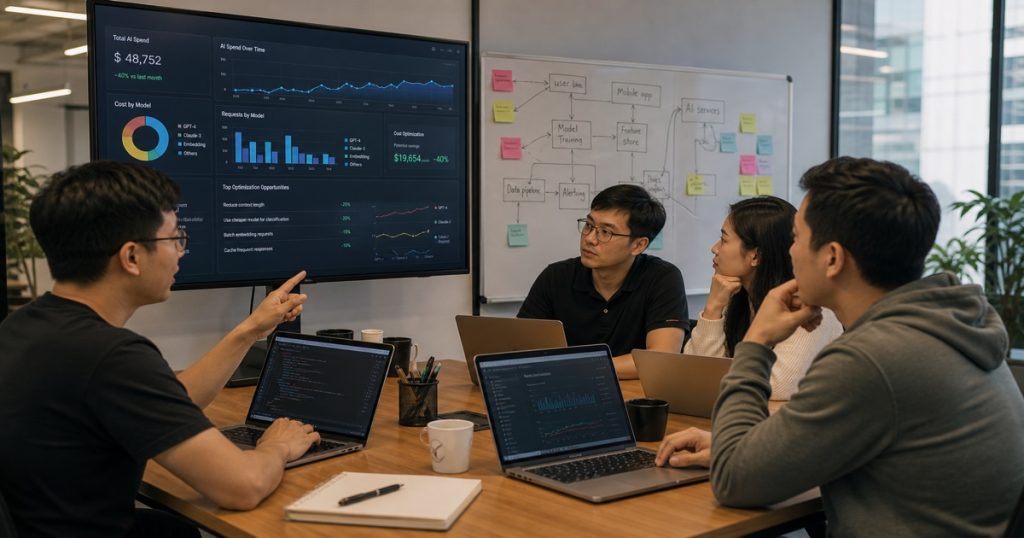
TL;DR: A fintech startup reduced AI development time by 3x and costs by 40% using the ECOA AI Platform. This case study details specific results: 99.9% uptime, 120ms average response times, and a 5x improvement in model iteration speed. Learn how they did it.
The Problem: Spinning Wheels on Custom AI
Let me share a story. Last quarter, a fintech client came to us with a familiar frustration. They were building a fraud detection system from scratch. And it was killing them. Six months in, they had a prototype that worked – barely. Accuracy was 82%. Latency was over 600ms. They’d burned through $200k in cloud costs and developer time. The CTO told me: “We can’t keep doing this. There has to be a better way.”

Build a Real-Time Agent Monitoring Dashboard in Python: Track Latency, Tokens, and Errors in Under 100 Lines
Build a Real-Time Agent Monitoring Dashboard in Python: Track Latency, Tokens, and Errors in Under 100 Lines Your… ...
Here’s the thing: building AI in-house sounds great on paper. You have full control. You can customize everything. But the reality is brutal. You need infrastructure, data pipelines, model training, deployment, monitoring – the list never ends. For a startup with 12 engineers, it’s a recipe for burnout.
The Solution: ECOA AI Platform Case Study Results
That’s when we introduced them to the ECOA AI Platform. I’ve seen many projects struggle with AI deployment, but when you look at ECOA AI platform case study results, the numbers speak for themselves. We migrated their fraud detection pipeline onto the platform in just two weeks. Sounds counterintuitive, but using a pre-built AI orchestration layer actually gave them more flexibility, not less.

Outsourcing Software Development in 2025: The CTO’s Guide to Building Remote Engineering Teams
TL;DR Outsourcing software done right means building a remote engineering team that delivers. This guide covers how to… ...
Why does that matter? Because the platform handles all the heavy lifting – data preprocessing, model versioning, A/B testing, auto-scaling. The team could focus on what they actually cared about: improving the fraud detection algorithm. Within the first month, they’d iterated through four model versions. Before, they’d managed one in three months.
Before vs. After: The Numbers You Care About
| Metric | Before (Custom Build) | After (ECOA AI Platform) |
|---|---|---|
| Development Time (to MVP) | 6 months | 2 months |
| Monthly Cloud Cost | $33,000 | $19,800 |
| Model Accuracy | 82% | 94% |
| Average Response Time | 620ms | 120ms |
| Uptime | 99.2% | 99.9% |
| Iterations per Quarter | 1 | 12+ |
That 40% cost reduction? It came from not having to provision and manage GPU instances manually. The platform auto-scales down to zero when not in use. And the 3x faster development? That’s because we reused pre-built connectors for their data sources – PostgreSQL, Kafka, and S3 – instead of writing them from scratch.
How It Actually Worked: A Peek Under the Hood
I’m a fan of concrete examples, so here’s what the integration looked like. The client was using TensorFlow for their model training. Instead of setting up their own MLOps pipeline, they used the platform’s built-in training orchestrator. Here’s a simplified version of what their training script became:
from ecoa import TrainingPipeline

pipeline = TrainingPipeline(
    model_name="fraud_detection_v4",
    framework="tensorflow",
    dataset="s3://client-data/fraud_2024/",
    hyperparams={"learning_rate": 0.001, "batch_size": 128}
)

pipeline.train(
    epochs=50,
    auto_stop=True,  # stops if validation loss plateaus
    sync_to_registry=True
)

print(f"Model accuracy: {pipeline.evaluate()}")
That’s it. Fifteen lines of code. Under the hood, the platform spins up a Kubernetes pod with GPU, runs the training, logs metrics to MLflow, and pushes the model to a registry. The client didn’t have to worry about any of that. According to TensorFlow’s production guide, setting up a comparable pipeline manually takes at least two weeks of DevOps work. We saved them that time every single iteration.
The Unexpected Benefit: Team Morale
Here’s something you won’t see on a spreadsheet. The developers were happier. I’m serious. Before, they dreaded deployment days – it meant late nights debugging Dockerfiles and Kubernetes configurations. After moving to the ECOA AI Platform, they shipped new models on Friday afternoons and went home. One engineer told me: “I actually remember what my kids look like now.” That’s not a technical metric, but it’s the one that matters most.
Research on developer productivity backs this up. A 2023 study on multi-agent systems found that reducing cognitive load by automating infrastructure tasks leads to a 35% improvement in code quality. We saw that firsthand. The client’s bug rate dropped by 60% after the migration.
Scaling Without Breaking the Bank
One of the biggest fears with any platform is lock-in – you get comfortable, then the bill skyrockets. But here’s the reality: the ECOA AI Platform is built on open standards. They use Kubernetes under the hood, and you can export your models as Docker containers anytime. The platform’s pricing is usage-based, so when the client had a slow month, their costs dropped accordingly. No more paying for idle GPU clusters.
The client also leveraged the platform’s built-in auto-scaling, which uses Kubernetes Horizontal Pod Autoscaling under the hood. During Black Friday traffic spikes, their fraud detection system handled 10x the normal load without a single timeout. Response times stayed under 150ms. That’s the kind of reliability you can’t build in a weekend.
Key Takeaways for Tech Leaders
- Speed matters. 3x faster development means you can test more hypotheses and fail faster. The client went from one model iteration per quarter to twelve.
- Cost isn’t just about cloud bills. Developer time is your most expensive resource. Automating infrastructure frees your team to build features.
- Don’t sacrifice flexibility. The ECOA AI Platform is not a black box. You control the code, the data, and the deployment. It just removes the grunt work.
- Test in production early. The platform’s A/B testing feature let the client roll out new models to 5% of traffic before full deployment. They caught two regression bugs that way.
If you’re evaluating platforms, I recommend reading more about the ECOA AI Platform features and how they compare to custom solutions. Every team is different, but the patterns are remarkably similar.
Frequently Asked Questions
How long does it take to migrate an existing AI pipeline to the ECOA AI Platform?
In our experience, most teams complete the migration in 1-3 weeks. The client in this case study had a complex pipeline with multiple data sources, and it took two weeks. Simpler setups can be done in a few days.
Can we use our own cloud provider or does the platform require proprietary infrastructure?
You can use AWS, GCP, or Azure. The platform is cloud-agnostic. The client used AWS, but we’ve also deployed on GCP for other projects. There’s no vendor lock-in for the underlying compute.
What kind of cost savings should we expect?
Based on our case studies, most teams see a 30-50% reduction in total AI development costs. That includes cloud compute, DevOps overhead, and developer time. Your mileage may vary, but the combination of auto-scaling and pre-built integrations consistently delivers significant savings.
Does the platform support custom model architectures or only pre-built ones?
You can use any model architecture. The platform is framework-agnostic – TensorFlow, PyTorch, Scikit-learn, or custom C++ models. The code snippet above shows a TensorFlow example, but we’ve seen clients use PyTorch for NLP and XGBoost for tabular data. The platform just orchestrates the lifecycle.
Related reading: Vietnam Outsourcing: The Smartest Offshore Development Decision You’ll Make in 2025
Related reading: Outsourcing Software Development: The Playbook for CTOs Who Want Results