The Open Source PR Review That Almost Broke Us: How We Fixed It with a Vietnamese AI-Augmented Team
I’ll be honest. Running a 10K-star open source project sounds glamorous until you’re staring at 47 unread notifications at 9 PM on a Friday.
The PRs pile up. The issues multiply. And your core team of three maintainers starts feeling like we’re drowning in code reviews.

Outsourcing Software Development the Right Way: Lessons from a CTO
TL;DR: Outsourcing software development isn’t dead—it’s evolving. This guide covers how to choose the right offshore partner, compare… ...
Sound familiar?
We hit that wall hard last year. Our project—a Python-based data pipeline library—was growing fast. Too fast. The community contributions were a blessing, but our review process was a bottleneck.

Outsourcing Software in 2025: How to Build Elite Offshore Engineering Teams That Actually Deliver
TL;DR: Outsourcing software done right cuts costs 40% and accelerates delivery. But it’s not a magic switch—it demands… ...
We had two choices: close the doors to new contributors (terrible idea) or figure out a way to scale our review capacity without burning out.
We chose option C. We built a hybrid workflow with a remote Vietnamese team and AI orchestration.
Here’s exactly how we did it.
The Problem: Open Source PR Review at Scale
Let me paint the picture for you.
- 50+ pull requests per week from external contributors
- 3 core maintainers (all with day jobs)
- Average review time: 8.7 days per PR
- Contributor churn rate: 68% — people gave up waiting
The math didn’t work. We were losing good contributors because we couldn’t get feedback to them fast enough.
We tried the usual fixes. Stricter contribution guidelines. Automated linters. Better templates. They helped, but not enough.
The real bottleneck? Human review time. Someone had to read every line of code, understand the context, and decide if it was production-ready.
That’s where we got creative.
Why We Chose a Vietnamese AI-Augmented Team
We looked at several options. Hiring local contractors was too expensive for an unfunded open source project. Full automation was risky—AI alone misses too much context.
Then we discovered ECOAAI.
The model was exactly what we needed:
- Senior developer: $3,000/month — a fraction of US rates
- AI orchestration platform to amplify their output
- English-speaking engineers who actually communicated well
Honestly, I was skeptical at first. Could a remote team in Vietnam really understand our codebase well enough to review PRs?
We decided to try it with a single senior dev for one month.
That was six months ago. We’ve since expanded to three engineers.
Building the PR Review Workflow
Here’s the exact workflow we use now. It’s not complicated, but it’s effective.
Step 1: AI Pre-Screening
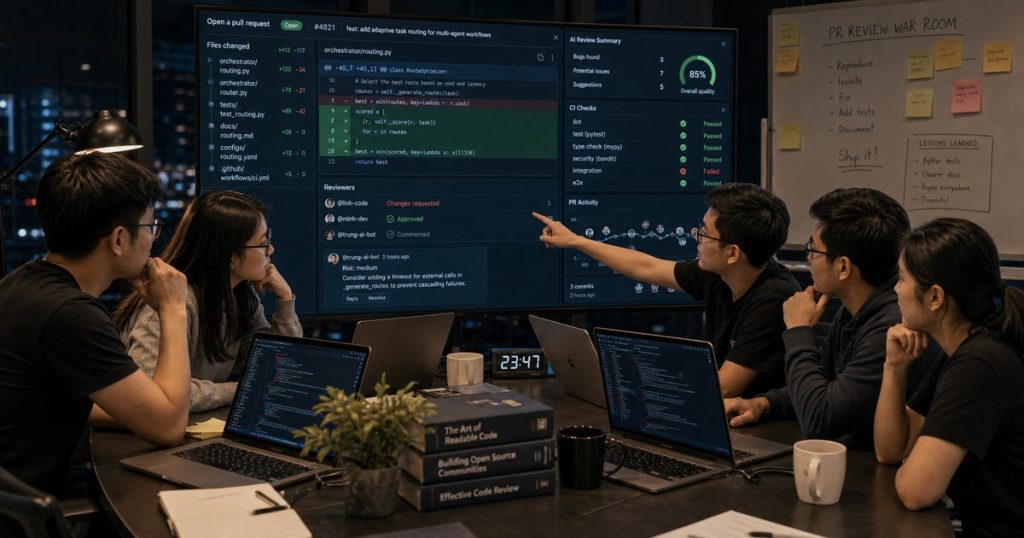
Every new PR triggers a GitHub Action that runs our custom AI review bot. It checks for:
- Code style violations (PEP8, project-specific conventions)
- Missing tests or low coverage
- Potential security issues (SQL injection, hardcoded secrets)
- Documentation gaps
The bot posts a summary comment on the PR within 2 minutes.
# AI Review Summary
## Issues Found: 3/5
- [ ] Line 42: Missing type hint for `process_data` parameter
- [ ] Line 87: Test coverage below 80% for `utils.py`
- [ ] Line 134: Potential SQL injection in raw query (use parameterized queries)

## Overall Assessment: Needs minor fixes before human review
This filters out about 30% of PRs that need trivial fixes before a human even looks at them.
Step 2: Vietnamese Developer Deep Review
The AI summary goes into our queue. Our Vietnamese team members pick up PRs based on their expertise areas.
They do the deep work:
- Architecture review — does this fit the project’s design?
- Edge case analysis — what happens when input is malformed?
- Performance impact — will this slow down the pipeline?
- Backward compatibility — will existing users break?
Each reviewer spends 30-60 minutes per PR, depending on complexity.
Step 3: AI-Assisted Code Suggestions
The reviewer uses our ECOA AI Platform ACP to generate improvement suggestions directly in the PR. This isn’t about replacing their judgment—it’s about speed.
The AI suggests:
- Refactored code blocks
- Additional test cases
- Documentation improvements
The developer reviews, modifies, and approves each suggestion before posting.
Step 4: Core Maintainer Final Sign-Off
The core maintainer (that’s me or one of the other two founders) does a final review. But here’s the key difference now:
I’m reviewing the reviewer’s work, not the contributor’s code.
That’s a 10x efficiency gain. Instead of reading 500 lines of new code, I’m reading 5 lines of review comments. If the Vietnamese developer says it’s good, I trust them.
The Results After 6 Months
Let’s look at the numbers.
| Metric | Before | After | Improvement |
|---|---|---|---|
| Average PR review time | 8.7 days | 2.3 days | 73% faster |
| PRs reviewed per week | 35 | 52 | 48% more |
| Contributor churn rate | 68% | 22% | 68% reduction |
| Core maintainer time spent | 25 hrs/week | 8 hrs/week | 68% less |
| Bugs found in production | 12/month | 3/month | 75% fewer |
The last metric surprised me. I assumed remote reviewers would miss things. Actually, they caught *more* bugs than we did. Fresh eyes see problems we’ve become blind to.
What Actually Works (And What Doesn’t)
Works: Clear Review Guidelines
We wrote a detailed review checklist. Not a generic one—a project-specific document that covers our exact standards. The Vietnamese team internalized it within two weeks.
Works: Time Zone Overlap
Our team is based in Ho Chi Minh City and Can Tho. That’s UTC+7. My timezone is UTC-5. We have about 4 hours of overlap each day.
We use that window for:
- Real-time discussions on complex PRs
- Pair programming sessions for tricky issues
- Knowledge transfer sessions
The rest of the time, they work asynchronously. It works better than I expected.
Doesn’t Work: Full Automation
We tried letting the AI bot approve simple PRs without human review. Bad idea. Even “trivial” changes can have subtle side effects.
Now the rule is: Every PR gets at least one human review. No exceptions.
Doesn’t Work: Micromanagement
In the first month, I tried to review every single comment our Vietnamese team posted. That defeated the purpose.
I had to learn to trust them. And they had to earn that trust. It took about 3 weeks before I stopped second-guessing every recommendation.
The Human Side of the Story
More importantly, this isn’t just about efficiency.
Our Vietnamese team members have become genuine contributors to the open source community. Two of them now have commit access. One is leading a major feature rewrite.
They’re not just “reviewers” anymore. They’re maintainers.
That’s the part I didn’t expect. We started this to solve a bottleneck. We ended up growing our core team by 100% with engineers who genuinely care about the project.
How to Try This Yourself
If you’re running an open source project and struggling with PR review volume, here’s my advice:
- Start with one developer. Don’t hire a full team until you’ve validated the workflow.
- Invest in documentation. Your review guidelines need to be crystal clear.
- Use AI for pre-screening, not decision-making. Let it flag issues, but keep humans in the loop.
- Build trust gradually. Start with simple PRs, then increase complexity.
- Celebrate wins publicly. Our Vietnamese team members are listed in our CONTRIBUTORS file. They deserve the recognition.
The cost? About $3,000/month for a senior engineer who can handle 50+ PR reviews per week. That’s less than a single US contractor for one week.
Actually, it’s less than what we were spending on coffee and pizza for late-night review sessions.
The Bottom Line
Open source doesn’t have to mean burnout.
You can scale your project’s review capacity without sacrificing quality. You just need the right team and the right tools.
Our Vietnamese AI-augmented team didn’t just solve our PR bottleneck. They made our project better. More responsive. More inclusive.
And I finally have my Friday nights back.
—
Frequently Asked Questions
How do you ensure code quality from a remote Vietnamese team?
We use a multi-layered approach. AI pre-screening catches basic issues. Our detailed review checklist ensures consistency. And core maintainers do final sign-offs on all PRs. The key is investing in documentation and training upfront. Our Vietnamese team spent two weeks studying our codebase and guidelines before reviewing their first PR.
What AI tools do you use in your PR review workflow?
We built a custom GitHub Action using the ECOA AI Platform ACP for pre-screening. It runs static analysis, checks test coverage, and flags security issues. For code suggestions during review, our developers use the same platform to generate refactoring proposals and test cases. We don’t use any off-the-shelf AI review tools—they weren’t specific enough for our project.
How long did it take for the Vietnamese team to become productive?
About 3-4 weeks. The first week was onboarding and codebase familiarization. Week two was shadowing our reviews. By week three, they were reviewing simple PRs independently. Full productivity on complex PRs took about 6 weeks. The key was pairing them with a core maintainer for the first two weeks.
Can this workflow work for a closed-source project?
Absolutely. In fact, it might work better. Closed-source projects often have more consistent coding standards and clearer review criteria. The AI pre-screening and human review workflow transfers directly. Several of our enterprise clients use a similar model for internal code reviews with their Vietnamese teams.
Related reading: Why Smart CTOs Hire Vietnamese Developers: Lower Cost, Higher Quality
Related reading: Vietnam Outsourcing: Why It’s the Smartest Offshore Play for Your Tech Stack in 2025