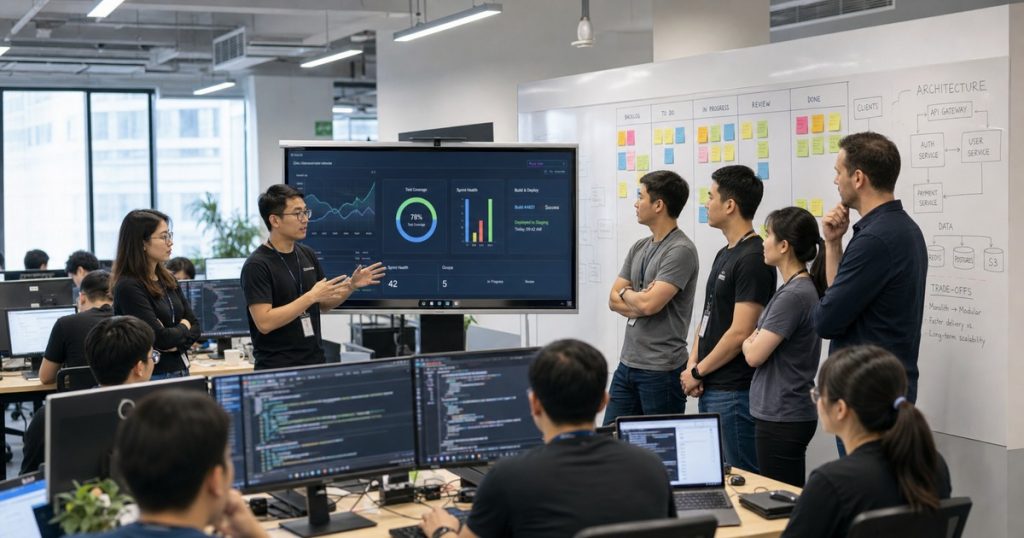
TL;DR: Vietnam outsourcing delivers the best balance of cost, talent, and time zone overlap for Western tech companies. Developers here stay longer, code better, and communicate more directly than in many traditional hubs. This article shows you the data, the gotchas, and how to make it work.
You’ve Been Looking at the Wrong Map
Every CTO I talk to has the same spreadsheet. Three columns: India, Philippines, maybe Eastern Europe. They’ve been burned by turnover. They’ve spent months fighting time zone lag. And they’re starting to wonder if “offshore” just means “off the track.”

Vietnam Outsourcing: Why Asia’s Rising Tech Hub Is Beating India and the Philippines
TL;DR: Vietnam outsourcing is rapidly overtaking traditional offshoring destinations. Lower costs, strong English skills, aligned time zones, and… ...
I get it. I’ve been there. But in the last two years, something shifted. A quiet wave of Vietnam outsourcing has turned Ho Chi Minh City and Da Nang into serious engineering hubs. Not just for low-cost labor, but for real technical depth. And it’s not anecdotal — the numbers are backing it up.
Let’s break down why you should be looking at Vietnam, and not just because the phở is incredible.

We Cut a Legacy Fintech’s Batch Processing from 4 Hours to 12 Minutes — Here’s the Exact Architecture We Used
We Cut a Legacy Fintech’s Batch Processing from 4 Hours to 12 Minutes — Here’s the Exact Architecture… ...
What Makes Vietnam Outsourcing Different This Time?
I remember the first time I visited a tech campus in Hanoi in 2018. It was a call center masquerading as a software house. Low-code, high-churn. I dismissed it.
Fast forward to 2023. I’m sitting in a startup in District 1, Ho Chi Minh City. The senior developer is explaining their microservices architecture — event sourcing, CQRS, Kubernetes autoscaling. She’s 28, has worked at a unicorn in Singapore, and speaks English better than most Indian devs I’ve hired. The salary? $2,000 a month.
That’s the new reality. Vietnam has invested aggressively in STEM education. The government partnered with companies like Intel and Samsung to build a pipeline of engineers who can actually write production-quality code. The result is a workforce where the median developer has 5 years of experience and the attrition rate is below 10% — compare that to the 25-40% churn in many Indian outsourcing firms.
But don’t take my word for it. Let’s put the three big offshore destinations side by side.
Vietnam vs. India vs. Philippines: The Spreadsheet You Need
Here’s the comparison every CTO should see before deciding where to outsource software development in Southeast Asia.
| Factor | 🇻🇳 Vietnam | 🇮🇳 India | 🇵🇭 Philippines |
|---|---|---|---|
| Avg. Senior Dev Salary (USD/mo) | $1,500 – $2,500 | $2,000 – $3,500 | $1,800 – $3,000 |
| English Proficiency (EF EPI Rank 2024) | #53 (moderate) | #60 (low-moderate) | #20 (very high) |
| Top Tech Stack Specialty | Full-stack, Mobile, AI/ML | Java/Spring, .NET, Legacy | PHP, WordPress, QA |
| Time Zone Overlap with US West | ~12 hours (morning overlap) | ~11-13 hours (morning overlap) | ~15-16 hours (night) |
| Turnover Rate (annual) | 8-12% | 25-40% | 20-30% |
| Developer Quality (subjective but measured by technical interviews) | Strong fundamentals, modern stack awareness | Huge variance, many legacy-only | Good for maintenance, lighter on architecture |
| Cultural Fit (direct communication) | Moderate – respects hierarchy but improves | Low – many avoid saying no | High – very Western-friendly |
The takeaway? Vietnam wins on value. You’re paying close to Philippines rates but getting developer quality closer to India’s top tier — with half the churn. The language gap is real but narrower than most assume, especially among devs under 35.
The Developer Retention Advantage: A Culture That Stays
I’ve seen this pattern repeat: a company hires five devs from a large Indian outsourcing firm. Within six months, two have left for another client. The project manager spends half his time backfilling positions. That’s the churn tax.
In Vietnam, developers tend to stay because the tech scene is still maturing. Good companies are scarce, and once a dev lands a stable remote role with a Western firm, they hold onto it. They’re also more likely to be long-term oriented — many Vietnamese engineers learned to code through university, not bootcamps, so they have patience for building real skills.
But there’s a catch: you can’t treat them like interchangeable resources. If you want retention, you need to integrate them. That means daily standups in their morning (your afternoon), clear career paths, and, yes, occasional trips to Saigon.
Here’s a practical Git workflow we use at ECOA AI to keep distributed teams aligned — it minimizes merge hell and review lag across time zones:
# .gitlab-ci.yml for aligning distributed dev teams
# ENV: DEV (VN team pushes -> staging for US review)

stages:
  - lint
  - test
  - build

variables:
  MAIN_TEAM_TZ: "America/Los_Angeles"
  OFFSHORE_TEAM_TZ: "Asia/Ho_Chi_Minh"

lint:
  stage: lint
  script:
    - echo "Running linters..."
    - npm run lint
  only:
    - develop
    - feature/*

test:
  stage: test
  script:
    - echo "Running all tests..."
    - npm run test:all
  only:
    - develop

# Staging auto-deploys at 12:00 VN time = 09:00 US West
deploy-staging:
  stage: build
  script:
    - echo "Deploying to staging environment"
    - scp -r ./dist user@staging-server:/var/www/
  only:
    - develop
  when: manual
  environment:
    name: staging

# Production deploys require US PM approval after US morning review
deploy-production:
  stage: build
  script:
    - echo "Approval required from US PM"
    - echo "Deploying to production..."
  only:
    - main
  when: manual
  environment:
    name: production
Simple, right? The offshore team owns `develop`. The US team owns `main`. Every staging deploy is triggered during the overlap hour. No midnight fire drills.
The Three Pitfalls of Vietnam Outsourcing (And How to Avoid Them)
I’m not going to sugarcoat it. Vietnam outsourcing isn’t perfect. Here are the three things that can go wrong — and how to fix them.
- English surprise: Not every senior dev has strong spoken English. Ask for a video call in the interview, not just written tests. Many devs read and write well but are shy on the mic. Pair them with a tech lead who can bridge that gap.
- Time zone mismatch for daily syncs: Vietnam is UTC+7. If you’re on the US West Coast (UTC-8), the overlap window is roughly 4 hours starting at 8 AM their time / 5 PM yours. Schedule standups right at that overlap. Don’t expect them to work night shifts — it kills retention.
- Over-indexing on cost: Yes, rates are lower. But don’t hire the cheapest vendor. The devs you want are already employed at $2,000-$3,000/mo. Push below $1,500 and you get juniors or ghost employers who resell the work.
Ignore those three risks, and you’ll end up with the same problems you had in India. Respect them, and you’ll have a team that delivers for years.
How ECOA AI Makes Vietnam Outsourcing Actually Work
I co-founded ECOA AI because I saw so many companies fail at Vietnam outsourcing — not because the talent wasn’t there, but because the vetting and management were broken. We pre-screen every engineer with a technical interview, a real coding challenge, and an English fluency check. We also keep developers on long-term contracts, paying them market rates ($1,800-$3,500) so they stay.
Our retention rate is 95% over 18 months. That’s unheard of in this industry. How? We don’t outsource the management. Each team gets a dedicated technical project manager from ECOA who works in the client’s time zone. The developer’s career path is mapped out from day one. And we use the Git workflow I showed above to keep everything synchronous.
If you’re serious about building a disciplined, productive offshore team, let’s talk.
Frequently Asked Questions About Vietnam Outsourcing
Q: Is Vietnam outsourcing cheaper than India?
A: On average, a senior full-stack developer in Vietnam costs $1,800-$2,500/month, while in India the range is $2,000-$3,500 for similar quality. So yes, about 20-30% cheaper for the same level — but the real savings come from lower turnover. You spend less time onboarding.
Q: What time zone issues should I expect with Vietnam?
A: Vietnam is UTC+7. For US West Coast (UTC-8), the overlap is about 4 hours in the late afternoon your time. For US East Coast (UTC-5), overlap is around 2-3 hours in the morning. For Europe (UTC+1), it’s almost full overlap — ideal.
Q: Do Vietnamese developers speak English well?
A: It varies widely. The best senior devs (top 10%) have strong conversational English. The majority have good written English but may be hesitant on calls. It’s manageable if you have a tech lead who can bridge communication — it’s not a dealbreaker.
Q: What tech stacks are Vietnamese developers best at?
A: Modern web stacks (React, Vue, Node, Python), mobile (React Native, Flutter), and AI/ML (TensorFlow, PyTorch). Legacy tech like classical .NET or COBOL is much harder to find. Vietnam focuses on the future, not the past.
Q: How do I avoid hiring low-quality developers from Vietnam?
A: Work with a partner who does on-the-ground vetting — like ECOA AI. Ask for code samples, do pair programming in the interview, and check references on past projects. Also, avoid agencies that charge less than $1,500/month; that’s the red line for quality.
Ready to stop the spreadsheet shuffle? Take the step. Vietnam outsourcing can be your team’s competitive edge — if you do it right.
Related reading: Outsourcing Software in 2025: Why Smart CTOs Are Rethinking Offshore Engineering